
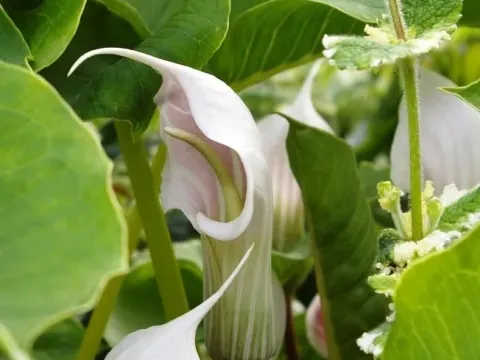
Arisaema candidissimum
Arisaema candidissimum
Arisaema candidissimum propagates primarily through seed sowing or by separating offsets from the main corm. Seeds should be sown immediately after ripening, as they lose viability quickly if allowed to dry out.
What the section contains
Arisaema candidissimum
For outdoor cultivation, sow seeds in autumn to benefit from natural cold stratification during the winter months, which significantly improves germination rates in spring.
Vegetative propagation involves gently detaching small cormlets from the parent plant during dormancy. This should be done carefully to avoid causing rot-prone wounds on the bulb surface.
Seedlings develop slowly and typically require three to four years of vegetative growth before they produce their first distinct inflorescence.
When planting corms, ensure they are placed in a well-drained medium at a depth of 5–10 cm depending on the size of the bulb.
As a member of the Araceae family, this species thrives in shady or semi-shaded environments, mimicking its native habitat in the mountains of China.
The soil must be rich in organic matter, slightly acidic, and exceptionally well-drained. Heavy clay soils that retain water must be amended with grit or sand to prevent rot.
Consistent moisture is required throughout the growing season, but the substrate should never be waterlogged. Proper air circulation is essential for the health of the foliage.
While the plant is hardy in many zones, it is advisable to protect the root zone with a thick layer of mulch in colder regions to prevent deep freezing of the soil.
During the dormant winter period, the plant must be kept relatively dry, especially if the corms are stored or mulched in high-rainfall areas.
The primary threat to Arisaema is tuber rot, caused by fungal pathogens that thrive in poorly drained or overly saturated soil conditions during dormancy.
Slugs and snails are the most frequent pests, as they are attracted to the succulent, emerging foliage in early spring, often causing significant aesthetic damage.
Aphids may infest the leaves during hot, dry spells, necessitating the use of insecticidal soap or biological controls to protect the plant's vitality.
Viral infections can sometimes occur, manifesting as mosaic patterns on the leaves. Infected plants should be removed and destroyed to prevent spreading.
To maintain a healthy garden, ensure that garden tools are sanitized between uses and that any decaying matter around the plant base is cleared away.