
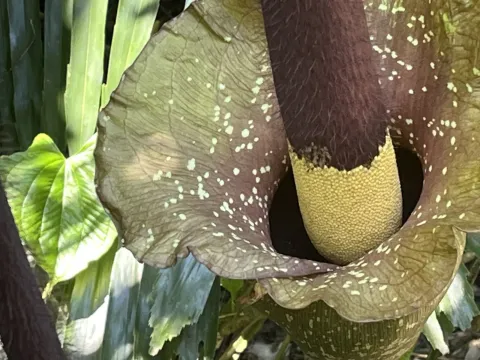
Amorphophallus hirtus
Amorphophallus hirtus
Amorphophallus hirtus is a perennial tuberous plant that is most commonly propagated vegetatively by separating daughter tubers from the parent plant during its dormancy phase. Planting the tubers in soil or containers is ideally performed in the spring when temperatures consistently reach 15–18 degrees Celsius.
What the section contains
Amorphophallus hirtus
In cases of propagation by seed, sowing should occur immediately after maturation, as the seeds lose viability rapidly. Seeds require a consistently moist substrate and a temperature of around 25 degrees; the first sprouts typically emerge several weeks after planting.
The planting depth for the tuber depends on its size; it is generally recommended to cover the tuber with a layer of soil equivalent to twice its diameter. This protects the tuber from desiccation and guides the sprout towards the surface.
Selecting the right site involves providing shade during peak sunlight hours, as direct solar radiation can damage the sensitive leaves that emerge as the growth cycle progresses.
Under greenhouse or indoor conditions, planting schedules may shift based on the specific growth cycle of the plant, as the species exhibits a distinct dormant period following the senescence of its foliage.
The plant requires a loose, nutrient-rich substrate with excellent drainage properties. A combination of peat moss mixed with perlite, vermiculite, and leaf mold, maintaining a neutral to slightly acidic pH level, serves as an optimal growing medium.
As a tropical species, it demands high air humidity and stable daytime temperatures between 22 and 28 degrees. Significant thermal fluctuations or cold drafts can severely inhibit the development of the subterranean storage organ.
Watering must be generous during the active vegetative growth phase, but waterlogging is strictly prohibited as it leads to rapid tuber rot. Ensuring that excess water drains away from the root zone is vital for plant survival.
During the dormant period, irrigation should be almost completely withheld, allowing the tuber to remain in a dry, cool environment until the next growth cycle begins. Lighting should be bright and indirect to ensure healthy photosynthesis without burning the foliage.
- High relative humidity levels (above 60%).
- Effective drainage to prevent moisture buildup.
- Ambient temperatures maintained above 15 degrees Celsius.
- Periodic fertilization with balanced nutrients during growth.
The primary threats to Amorphophallus hirtus involve bacterial and fungal rots resulting from poor agronomic practices. Excessive watering, especially when ambient temperatures are low, is the main risk factor promoting pathogen proliferation within the tuber tissue.
Pests such as spider mites and mealybugs may infest the foliage, particularly in environments with low air humidity. Immediate treatment with systemic insecticides or acaricides is required upon early detection of these pests.
Nematodes represent a significant threat to the root system, as they can bore into the tuber, causing deformation and rot. Prevention through the use of sterilized potting soil and quarantine of new plant additions is standard procedure.
Fungal leaf spots can weaken the plant during the active season. It is recommended to prune affected areas and apply copper-based fungicides to inhibit further spread of the infection.
Regular monitoring of tubers during their dormant storage period is essential to detect early signs of decay, which helps in preventing total crop loss and maintaining a healthy stock for the next season.
Harvesting the tubers is performed after the foliage has fully withered and nutrients have been retracted into the underground organ. This process occurs naturally in autumn or whenever the plant enters its physiological resting phase.
Tubers should be carefully lifted from the soil, cleared of substrate residues, and pruned of old roots. They should then be dried in a well-ventilated, moderate-temperature area to prevent mold formation on the skin.
For long-term storage, tubers are packed in dry peat or paper bags, kept at a stable cool temperature, and protected from mechanical stress. Frequent checks for firmness and health throughout the winter are mandatory.
Sharp, sterilized tools are essential for cutting large tubers into sections containing growth buds for mass propagation. Each section must be allowed to callus before replanting to prevent infection.
Properly harvested and cured planting material retains viability for several months, facilitating successful transport and storage until the initiation of the next vegetative season.