
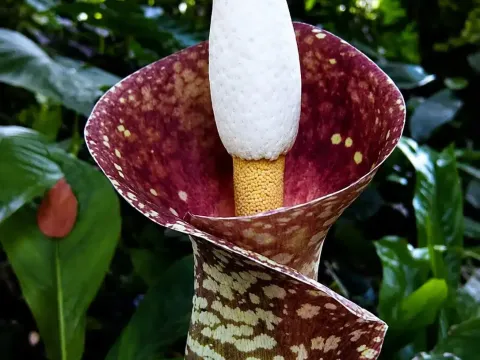
Amorphophallus oncophyllus
Amorphophallus oncophyllus
Planting of Amorphophallus oncophyllus usually takes place at the start of the rainy season when soil temperatures rise to 20-25°C. For large-scale production, tuber sections weighing 100 to 200 grams containing active buds are used for propagation.
What the section contains
Amorphophallus oncophyllus
Optimal planting density depends on the target tuber size; for industrial processing, spacing is typically 50-60 cm between plants. Planting depth ranges from 10 to 15 cm depending on the soil texture.
As a member of the Araceae family, this plant requires a long growing season to develop large, marketable tubers. In tropical regions, the growth cycle from planting to harvest lasts between 6 and 8 months.
Proper soil preparation is essential; fields should be plowed to a depth of 30 cm to allow the tubers to expand freely and to ensure adequate drainage during the rainy months.
To speed up germination, tubers can be pre-conditioned in protected, humid environments until the first roots begin to emerge, facilitating faster establishment in the field.
The crop thrives in loose, fertile loamy or sandy soils with a pH ranging from 6.0 to 7.0. High levels of organic matter are critical for achieving high tuber quality and yield.
Amorphophallus oncophyllus requires semi-shaded conditions, especially during the early stages of development. Direct sunlight may cause leaf scorching and reduce photosynthetic efficiency.
The optimal temperature range for growth is between 25°C and 35°C. The plant is sensitive to significant temperature fluctuations and prolonged drought, which can inhibit tuber expansion.
Irrigation should be consistent but managed to prevent waterlogging, which quickly leads to tuber rot. Maintaining excellent field drainage is a primary requirement for crop health.
Fertilization programs typically focus on balanced NPK ratios with an emphasis on potassium, which supports the accumulation of polysaccharides in the developing tuber.
Yields of Amorphophallus oncophyllus vary based on agricultural management and climate. Under optimal conditions, farmers can achieve between 20 and 40 tonnes of tubers per hectare.
The core objective of cultivation is to maximize the content of glucomannan, a dietary fiber highly valued in various industries. Tuber age and soil fertility are the main drivers of quality.
Using high-quality planting material significantly improves results, as vigorous early growth is directly correlated with the final tuber size at the end of the season.
Precision irrigation systems, such as drip lines, have proven effective in stabilizing yields and ensuring consistent growth even during inconsistent rainfall periods.
The economic profitability of this crop is linked to the global demand for glucomannan, which is extensively used in the food industry as a thickener and in health products.
Soft rot caused by bacterial pathogens such as Erwinia carotovora is the most significant threat. It thrives in waterlogged soil and spreads rapidly if tubers are mechanically injured during handling.
Nematodes are serious soil-borne pests that damage the root system, leading to stunted plant growth and a drastic reduction in total harvest weight.
Various insect larvae can feed on the foliage, reducing the plant's ability to photosynthesize and store starch, which ultimately impacts the size of the final tuber.
Fungal diseases in the root zone must be managed through strict crop rotation and the application of appropriate fungicides if symptoms are detected early.
- Routine field inspections for early detection of wilting or diseased plants.
- Immediate removal and disposal of infected plants away from the cultivation area.
- Pre-planting soil treatment to suppress soil-borne pest populations.
Harvesting commences when the above-ground foliage begins to turn yellow and senesce naturally, indicating that the nutrients have successfully translocated into the tuber.
Mechanical harvesting requires extreme care to avoid nicks or abrasions on the skin of the tubers, as these wounds serve as entry points for pathogens during storage.
After harvest, tubers should be cured in a shaded, well-ventilated area for several days to reduce surface moisture and allow minor skin wounds to heal.
Once cured, the harvest should be graded by size and quality, with the most robust and healthy tubers kept as seed stock for the next planting cycle.
Proper long-term storage requires cool, low-humidity conditions, which prevent early sprouting and the onset of storage rots, ensuring the product reaches the market in peak condition.