
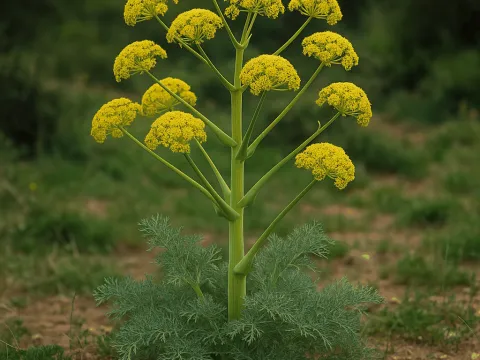
Ferula narthex
Ferula narthex
Ferula narthex is a perennial herbaceous plant belonging to the Apiaceae family. It is a robust succulent perennial capable of developing a deep root system adapted to arid environments.
What the section contains
Ferula narthex
The plant originates from the mountainous regions of Central Asia and Afghanistan. In its natural habitat, it prefers open sunny areas with rocky or sandy soils, where moisture stagnation is excluded.
The crop is highly demanding of light and does not tolerate shading well. Optimal growth conditions include significant fluctuations between day and night temperatures, typical for foothill and mountainous ecosystems.
Soils must be well-drained, with a neutral or slightly alkaline pH level. In heavy clay soils, the root system of Ferula is prone to rotting, which leads to the death of the entire plant at an early age.
Agricultural techniques require minimal intervention in the natural development cycle, but in the initial stages, it is important to provide protection against weeds that can suppress young Ferula seedlings.
The economic use of the crop is focused on extracting milky sap (resin), known as asafoetida. Yield depends on the age of the plant and growing conditions; harvesting typically begins at 4 to 5 years of age.
The collection process involves cutting the root collar or the upper part of the root, from which thick sap is secreted. Upon drying in the air, it turns into a solid resinous mass used in medicine and cooking.
The biological characteristics of the plant allow for raw material collection over several seasons from a single specimen if gentle tapping techniques are followed. Excessive harvesting leads to premature root depletion.
On an industrial scale, the yield of the finished product per hectare of plantation varies significantly depending on planting density and the climatic conditions of the cultivation region.
The quality of the resin is determined by the content of sulfur compounds and essential oils, the concentration of which depends on the timeliness of harvesting and the correctness of drying the raw material.
The main threat to Ferula is root rot, which occurs when irrigation patterns are violated or soil moisture is excessive. Prevention consists of selecting sites with excellent drainage.
Among the pests, wireworms and larvae of certain beetle species are the most dangerous, as they damage the underground part of the plant. In case of mass infestation, the use of targeted insecticides is required.
The plant can also suffer from aphid infestation during the flowering period, which reduces the overall viability of the crop and can lead to a shortage of seed material.
Weeds are the primary competitors for moisture and nutrients, especially in the first years of life; therefore, regular weeding is a mandatory step in agricultural management.
It is necessary to avoid mechanical damage to the stem during maintenance, as fungal infections often penetrate the plant tissues through wounds, provoking the development of necrosis foci.