
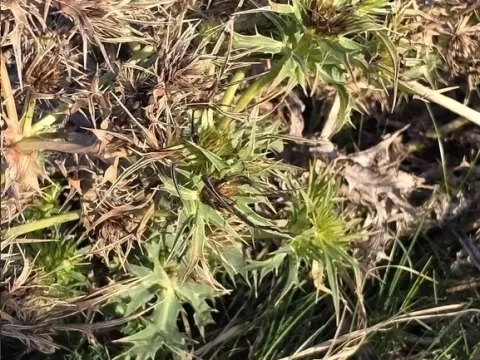
Field eryngo
Eryngium campestre
Field eryngo, known botanically as Eryngium campestre, is a perennial herb belonging to the Apiaceae family. It is recognized for its tough, drought-tolerant nature and its role in both medicinal and apicultural sectors.
What the section contains
Field eryngo
The propagation of this crop is primarily done through seeds. Due to seed dormancy, stratification is required for successful germination. Seeds should be sown in the late autumn, allowing them to experience winter cold, which naturally breaks the dormancy cycle.
If spring sowing is planned, seeds must be kept in a moist cold environment at temperatures near 4°C for at least six to eight weeks before being planted into the field. This mimics the natural seasonal cycle required for development.
Seeds should be sown in rows with a spacing of 40 to 50 centimeters. Given the plant's robust root system, adequate spacing is essential to allow the plant to establish its rosette of basal leaves effectively during the first year.
Early stage growth is characterized by significant focus on root development, which means that visible above-ground progress may appear slow. Proper site preparation, including clear weed control, is vital during this establishment phase.
This species is a quintessential xerophyte, thriving in dry, sunny, and open locations. It exhibits remarkable resilience to drought, making it an excellent candidate for cultivation in areas with limited water resources or on marginal, sandy, or rocky soils.
Soil drainage is the most critical factor for Eryngium campestre. The plant is highly sensitive to waterlogged conditions, which can lead to root rot and premature plant decline. Well-aerated, lime-rich (calcareous) soils are highly preferred.
Regarding climate, Field eryngo is hardy and capable of withstanding severe frost. It requires full sunlight exposure to maintain its characteristic morphology and to maximize the production of phytochemicals within its tissues.
Nutrient requirements are relatively low. Excessive application of nitrogenous fertilizers should be avoided, as it promotes lush vegetative growth that is prone to disease and reduces the concentration of beneficial secondary metabolites.
The plant performs well in soil with a neutral to alkaline pH. When integrated into landscapes or farm systems, it rarely requires supplemental irrigation once established, which minimizes operational costs.
The yield of Field eryngo is primarily valued for its utility in the pharmaceutical and cosmetic industries. The dry matter yield of the aerial parts typically ranges from 1.5 to 2.5 tons per hectare depending on the harvest intensity and plant density.
As a highly productive honey plant, Eryngium campestre provides a significant resource for apiaries. The nectar production is consistent, and the plant remains attractive to pollinators even during the peak of summer heat.
Root harvest, usually conducted every 2–3 years, yields significant quantities of medicinal material. The roots are valued for their saponin content, making them a high-value commodity in niche herbal markets.
To maximize yields, it is recommended to manage the plant stands by regular pruning of spent flower heads to encourage auxiliary growth, although care must be taken not to exhaust the root reserves.
Overall economic success depends on diversifying the harvest, utilizing both the biomass of the foliage and the medicinal properties of the harvested root systems.
The primary threats to Eryngium campestre cultivation are associated with excessive humidity rather than specific biological pests. Root rot, caused by fungal pathogens in damp soil, remains the most significant risk factor.
Foliar diseases, such as powdery mildew, may emerge in dense stands with poor air circulation. Ensuring adequate plant spacing and sunlight exposure usually prevents these outbreaks effectively without chemical intervention.
Small insects, such as aphids, may colonize the young growth during the spring season. However, because the plant contains various essential oils, it often displays a degree of natural resistance to widespread herbivore attacks.
Weed management is critical during the first year of production. Once the plant reaches maturity, its deep taproot and allelopathic characteristics allow it to dominate the surrounding area, limiting weed competition.
Proper post-harvest management is also a form of threat prevention. If material is stored with residual moisture, mold contamination will quickly render the entire batch unusable for pharmaceutical purposes.
Harvesting of the aerial parts occurs during the peak flowering stage, usually from July to August. It is at this time that the plant's essential oils and medicinal compounds are most concentrated.
The stems should be cut at a height of 10 to 15 centimeters above the ground. Harvesting must be performed during dry weather to ensure that the material does not begin to ferment or spoil before drying begins.
Roots should be harvested during the dormant phase in late autumn. After extraction, they must be cleaned thoroughly, split into smaller sections, and prepared for drying to prevent rot during the process.
Drying is performed in climate-controlled environments at temperatures between 40°C and 50°C. Maintaining these limits is essential to preserve the integrity of the chemical compounds found within the tissues.
Once dried to a moisture content of less than 12%, the product is packaged in breathable, moisture-proof containers to ensure a shelf life that can extend up to two years in cool, dark storage.