
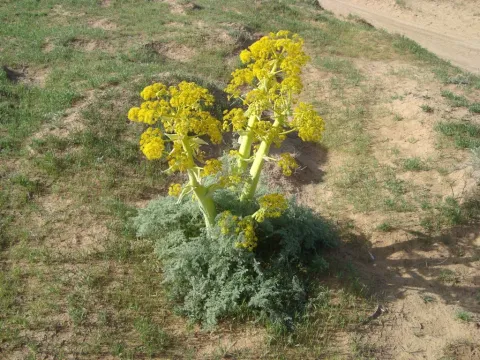
Ferula gummosa
Ferula gummosa
Ferula gummosa, a member of the Apiaceae family, is a perennial herb characterized by a strong taproot. Sowing is typically performed in late autumn or early spring, placing seeds at a depth of 2–3 centimeters in well-warmed soil.
What the section contains
Ferula gummosa
The seeds often require stratification to break dormancy and ensure uniform germination. During the first year, the plant grows slowly, primarily developing a basal rosette of leaves as it establishes its root system.
In commercial plantations, wide-row spacing of 60 to 80 centimeters is recommended to provide adequate space for mature plants. This spacing also facilitates mechanical weed control and subsequent harvesting operations.
Growth rate significantly accelerates from the second year onwards. The plant accumulates essential nutrients in its large taproot, which is a critical precursor for the subsequent production of valuable resin.
Soil preparation is essential for successful establishment. Fields must be free of perennial weeds and possess excellent drainage to support the growth of the sensitive root structure during the early stages of life.
This species is a typical xerophyte, adapted to arid and semi-arid climates. Ferula gummosa requires full sun exposure throughout the growing season and cannot tolerate shading, which negatively affects resin production.
The crop thrives in light, well-drained stony or sandy soils. Heavy clay soils that retain excess moisture should be avoided, as they significantly increase the risk of root rot and total plantation failure.
An optimal temperature range for active growth is between 20 and 30 degrees Celsius. While highly drought-tolerant, the plant benefits from adequate moisture during the early spring vegetative stage.
Soil pH should be neutral to slightly alkaline. The plant is noted for its tolerance to saline soils, making it a viable candidate for land reclamation or utilization of areas unsuitable for conventional staple crops.
While the species is hardy, protecting the crown of the plant during severe winters in certain regions can improve survival rates and maintain the health of the perennial root stock.
The primary economic product is galbanum, a thick gum resin harvested by making incisions in the root or base of the stem. Yield depends heavily on the plant's age and the specific resin-tapping technique employed.
Harvesting usually begins when plants reach 4 to 5 years of age, as this is when the concentration of secondary metabolites, including essential oils, is at its peak in the root tissue.
Productivity metrics are calculated based on the number of mature, healthy specimens per hectare. Consistent agricultural practices ensure a reliable and sustainable output of high-quality resin over the harvest season.
Economic viability is driven by the premium market price for galbanum in the fragrance and pharmaceutical industries. Proper cleaning and post-harvest handling are essential to maximize the market value of the raw material.
Besides resin, seeds and aerial biomass are utilized in various therapeutic applications. A diversified harvest strategy can improve the overall profitability of the cultivation enterprise.
Fungal pathogens represent the most significant threat to the crop, particularly in environments with poor soil drainage or high humidity. Root rot can quickly destroy an entire stand if not managed preventively.
Soil-dwelling insects pose a threat by feeding on the taproot, which may weaken the plant or provide entry points for secondary infections. Monitoring programs are necessary to identify outbreaks early.
Defoliating insects can impact the plant's photosynthetic capacity during the vegetative stage. Integrated pest management, minimizing chemical use, is crucial to maintain the purity required for medicinal and aromatic plant standards.
Weeds are strong competitors for nutrients and light, especially during the first two years. Maintaining a clean field environment is critical to ensure the crop develops to its full potential.
Adherence to a strict crop rotation schedule is the best preventative measure against soil-borne pathogens. Avoiding fields previously planted with other Apiaceae species reduces the risk of pest and disease carryover.
Harvesting involves carefully making incisions in the root zone to induce resin flow. The exuded milky sap hardens upon contact with air, forming the raw galbanum resin that is then collected manually.
This process is carried out in cycles over several weeks. Precision is required to ensure that the incisions do not cause structural damage or lead to irreversible decay of the root system.
Collected resin must be cleaned of debris and stored in airtight containers to preserve the volatile essential oils that give galbanum its unique fragrance and medicinal properties.
In many production systems, once the resin collection cycle is complete, the plants are considered spent. Replanting may be necessary to maintain the productive capacity of the plantation.
Seed collection is performed after the inflorescences fully mature. This practice is essential for providing self-sufficiency in propagation material for future planting seasons and expanding the cultivated area.