
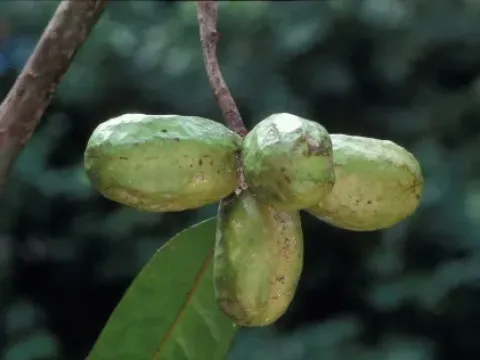
Sageraea
Sageraea
The genus Sageraea belongs to the family Annonaceae. These are evergreen trees or shrubs naturally occurring in the tropical rainforests of South and Southeast Asia, including countries like India, Sri Lanka, and Malaysia.
What the section contains


Sageraea
The plant thrives in humid tropical forest conditions. Successful growth requires consistently high ambient temperatures throughout the year and a total absence of frost, which is lethal to the development of this specific culture.
Sageraea has specific soil requirements: it prefers deep, fertile, and well-drained substrates. While it demands constant soil moisture, any waterlogging in the root zone must be strictly avoided to prevent the development of root rot and other pathogens.
In its natural habitat, Sageraea develops under the canopy of the forest, receiving diffused light. When introduced into cultivation, young seedlings require shading, whereas mature specimens are capable of tolerating more intense sunlight exposure.
Agronomic practices for this genus are not extensively studied due to limited industrial use. Propagation is primarily achieved through seeds, which must be sown immediately after harvesting as they tend to lose their viability very quickly.
The economic use of Sageraea is mainly focused on the extraction of its high-quality timber. The wood of certain species, such as Sageraea elliptica, is highly valued for its density, exceptional strength, and durability against environmental degradation.
In traditional medicine and local crafts, other parts of the plant, including the bark, leaves, and fruit, are utilized. The harvest of fruits is performed manually as they ripen, typically towards the end of the rainy season.
The timber is sought after for cabinet making, fine furniture, and specialized construction projects. Due to the slow growth rate of these trees, harvesting must be strictly managed to prevent the depletion of wild forest populations.
The collection of medicinal raw materials is limited to local needs. Both bark and leaves are gathered in small quantities, which does not currently support large-scale commercial production in the traditional sense.
Establishing commercial plantations remains a challenge due to the tree's lengthy maturity cycle. Consequently, the vast majority of raw material is still sourced from natural forests, highlighting the need for sustainable forestry and conservation efforts.