
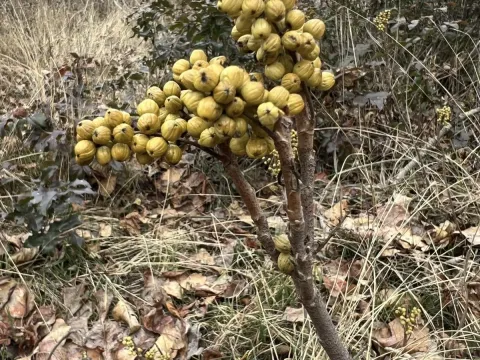
Rydberg's poison ivy
Toxicodendron rydbergii
Rydberg's poison ivy (Toxicodendron rydbergii) is a woody perennial shrub in the Anacardiaceae family. While not a cultivated crop, its presence in agricultural landscapes necessitates clear identification and management protocols.
What the section contains
Rydberg's poison ivy
Native to North America, this species is commonly found in meadows, rocky outcrops, and field margins. It lacks the climbing habit typical of related poison ivy species, instead growing as a distinct, upright shrub.
The plant thrives in a wide range of soil conditions, including sandy, loamy, and rocky soils. Its root system is particularly adept at extracting moisture, allowing the plant to persist in dry or marginal lands where standard crops may fail.
Climate-wise, it is highly resilient, surviving harsh continental winters and high-temperature summers. This adaptability allows it to compete effectively with native vegetation in disturbed habitats near farms.
Morphologically, it is recognized by its compound leaves consisting of three leaflets. The leaflets are usually larger and thicker than those of climbing variants, and they lack the aerial rootlets often seen on vine-like stems.
The primary concern regarding this plant is its production of urushiol, a potent contact allergen. This substance causes severe dermatitis, posing a significant risk to agricultural workers during cultivation and harvesting.
Typical plant pests, such as leaf-feeding beetles, are occasionally found on the foliage but do not effectively curtail the growth of this species. The plant's chemical defenses make it unpalatable to most livestock.
Diseases such as powdery mildew or fungal leaf spots occur in high-humidity environments. However, these infections are rarely fatal to the plant and do not serve as a viable biological control method.
Management usually involves the targeted application of systemic herbicides. Because the plant relies on underground rhizomes, mere cutting or mowing often leads to rapid regrowth, requiring repeated treatment cycles.
When implementing weed control strategies, personal protective equipment (PPE) is mandatory. Workers should avoid contact with all plant tissues and never burn vegetative debris to prevent systemic allergic reactions from smoke inhalation.