
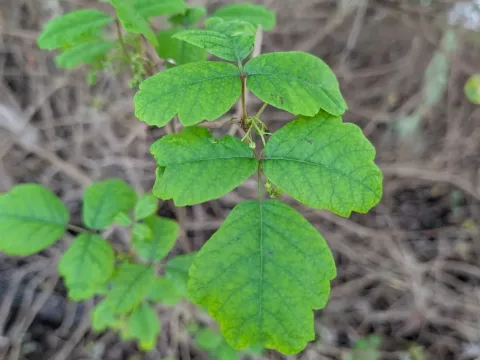
Pacific poison oak
Toxicodendron diversilobum
Pacific poison oak, or Toxicodendron diversilobum, is a perennial shrub or vine belonging to the Anacardiaceae family. Native to western North America, it ranges from British Columbia in Canada down to Baja California in Mexico.
What the section contains
Pacific poison oak
The plant exhibits remarkable adaptability, thriving in diverse habitats including coastal bluffs, oak woodlands, meadows, and shaded forest understories. It is highly resilient and can colonize disturbed sites, roadsides, and agricultural borders quickly.
It is not picky about soil quality, showing growth success on rocky outcrops, heavy clays, or sandy soils. Furthermore, the species is remarkably drought-tolerant, utilizing its deep root system to survive long, dry summers typical of the Mediterranean climate zones.
Morphologically, it is known for its leaves of three, which can vary greatly in appearance depending on environmental exposure. The plant produces urushiol, an oleoresin that causes severe contact dermatitis, serving as an effective evolutionary defense mechanism.
In terms of agricultural status, this plant is not a crop but rather a widespread weed. It has no commercial agricultural value and is generally managed as a significant public health hazard that requires removal from areas frequently accessed by farm workers or livestock.
Toxicodendron diversilobum has virtually no natural enemies in its native range due to the potent toxins stored in its leaves, stems, and roots. This resistance allows it to remain a dominant species in the undergrowth of various ecosystems.
There are no specific pests or plant diseases known to significantly reduce the population of this shrub. Consequently, invasive management programs rely heavily on mechanical removal and precise chemical herbicide application to mitigate its spread into active production fields.