
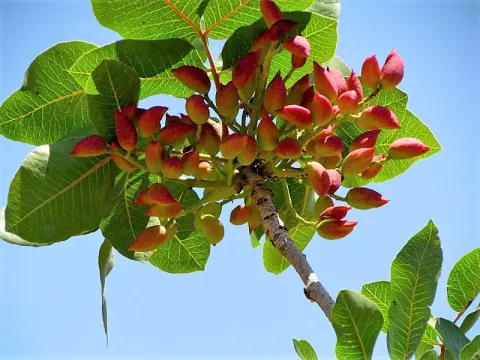
Pistachio
Pistacia L.
Pistachio (Pistacia L.) belongs to the Anacardiaceae family. It is a deciduous tree that has evolved to thrive in hot, semi-arid climates, making it an excellent candidate for regions with long, dry summers.
What the section contains
 Atlantic pistachio
Pistacia atlantica x Pistacia vera
Atlantic pistachio (hybrid with Pistacia integerrima)
Pistacia atlantica x Pistacia integerrima
Atlantic pistachio
Pistacia atlantica x Pistacia vera
Atlantic pistachio (hybrid with Pistacia integerrima)
Pistacia atlantica x Pistacia integerrima
 Chinese pistachio
Pistacia chinensis Bunge
Chinese pistachio
Pistacia chinensis Bunge
 Mastic tree
Pistacia lentiscus L.
Mount Atlas mastic tree
Pistacia atlantica Desf.
Mastic tree
Pistacia lentiscus L.
Mount Atlas mastic tree
Pistacia atlantica Desf.
 Pistacia integerrima
 J. L. Stewart
Pistacia integerrima
Pistacia integerrima J. L. Stewart
 Pistacia vera
 L.
Pistacia vera
Pistacia vera L.
 Turpentine tree
Pistacia terebinthus L.
Turpentine tree
Pistacia terebinthus L.
Pistachio
Originally native to Central and Western Asia, the pistachio is now commercially cultivated in several countries, including Iran, the United States (California), Turkey, and Mediterranean nations.
The tree requires full sun exposure and is highly intolerant of shade. It needs hot temperatures during the growing season to properly mature the nuts, while also requiring a sufficient period of winter chilling to break dormancy.
Deep, well-drained, and slightly alkaline or calcareous soils are ideal for pistachio cultivation. Its deep, vigorous root system allows it to withstand significant droughts, although irrigation is required for commercial-scale production.
When planting, it is critical to remember that the pistachio is a dioecious species. An orchard must contain a strategic ratio of male and female trees to ensure successful wind pollination and maximize the yield.
Pistachio yield is significantly influenced by tree age, cultivar selection, and orchard management. While trees start bearing at 7–10 years, full commercial maturity is typically reached between 15 and 20 years.
The crop exhibits an "alternate bearing" pattern, where high-yield years are followed by years of lower production. Proper irrigation and nutrient management can help stabilize this cycle to some extent.
A healthy, mature orchard can produce approximately 1.5 to 3 tons of dried nuts per hectare. On an individual tree basis, yield varies widely but can reach up to 20 kg per season in optimized conditions.
Pistachios are primarily used as a high-value snack nut, but they are also essential in the confectionery and baking industries, often used in ice cream, chocolates, and specialized culinary dishes.
Beyond the edible nuts, the pistachio tree provides high-quality timber and valuable resin (mastic), which is utilized in medical and cosmetic applications, adding additional value to the cultivation enterprise.
Fungal diseases, such as Botryosphaeria blight and various leaf spots, are the most significant threats to pistachio orchards. These thrive in conditions of high humidity or poor canopy management.
Insect pests, including the navel orangeworm and various scale insects, pose a serious threat to fruit quality. These pests attack the developing nuts, potentially causing significant economic losses.
Nematodes are another concern in specific soil types, where they attack the root system, reducing the tree's vigor and its ability to withstand environmental stress and other diseases.
Effective orchard management requires regular pruning to maintain an open canopy. This practice improves airflow, reduces moisture accumulation, and acts as a preventative measure against numerous pathogens.
Integrated Pest Management (IPM) is essential for modern orchards. By combining cultural practices with biological controls and targeted chemical treatments, growers can effectively manage threats while minimizing environmental impact.
Harvest time is identified by the maturation of the fruit, where the hull (epicarp) separates easily from the shell, and the shell splits naturally at the end of the nut, signaling full ripeness.
The harvest period typically occurs in late summer or early autumn. Timing is critical; delayed harvesting increases the risk of contamination, pest damage, and fungal development on the ripening nuts.
Modern commercial harvest is fully mechanized using mechanical tree shakers. These machines vibrate the tree trunk to drop the nuts onto catch frames, which is both efficient and gentle enough to prevent damage.
Immediately after collection, the outer hulls must be removed to prevent staining and rot. Rapid processing and drying are mandatory to ensure the quality and shelf-life of the final product.
After reaching the target moisture content, the nuts are stored in controlled environments. Proper temperature and humidity management are crucial to maintain the flavor profile and nutritional value for market distribution.