
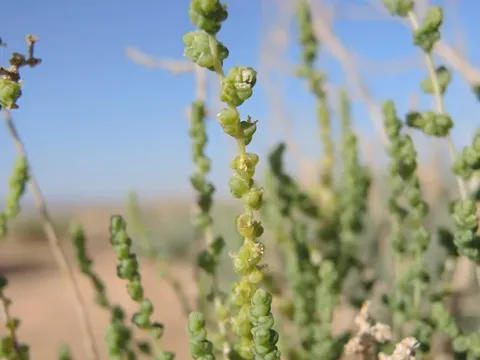
Salsola gaetula
Salsola gaetula
Salsola gaetula is a resilient shrub belonging to the Amaranthaceae family. It is a specialized halophyte adapted to extremely harsh environments, particularly in arid and semi-arid regions of North Africa and neighboring territories.
What the section contains
Salsola gaetula
The sowing season typically aligns with the onset of the rainy period, allowing seeds to utilize natural moisture for optimal germination. Under controlled agricultural settings, soil temperature should be maintained between 15 and 18 degrees Celsius for best results.
Seed preparation, such as soaking in water, is recommended to break dormancy and increase germination rates. Planting is usually conducted in rows, maintaining sufficient spacing to facilitate later maintenance and weed control efforts.
Initial growth is notably slow, and young plants are highly sensitive to competition from opportunistic weeds. Once the plant establishes its root system, it enters a phase of rapid development and biomass production.
A sowing depth of 1–2 centimeters is considered optimal. Sowing too deeply may inhibit seedling emergence, while surface sowing risks rapid desiccation of the seeds before they can establish a foothold in the substrate.
##requirements##This species is highly valued for its ability to thrive on saline soils that are completely unsuitable for standard cereal or vegetable crops. It serves as an essential component in land reclamation projects in saline zones.
Salsola gaetula requires full sun exposure for healthy development. Shading significantly impairs the photosynthetic efficiency of the plant, leading to reduced growth and diminished nutritional quality of the forage biomass.
The plant favors well-aerated sandy or loamy soils. Although it displays remarkable drought tolerance, waterlogged soil conditions are detrimental and can lead to root asphyxiation and the development of pathogenic fungi.
Climate adaptability is one of the plant's greatest strengths. It is capable of withstanding extreme temperature fluctuations and long-term precipitation deficits by utilizing succulent physiological mechanisms to retain moisture.
Agronomic management involves site selection with natural drainage properties. By improving soil physical structure, the plant acts as a natural barrier against erosion and desertification in marginal lands.
##yield##The primary economic application of Salsola gaetula is in livestock forage. It provides a vital survival feed for camels, goats, and sheep during seasonal periods when traditional pasture land fails to provide sustenance.
The nutritional profile of the green mass is high in minerals and crude protein, although the elevated salt content necessitates strategic feeding practices. It is often mixed with other feed sources to create a balanced diet.
Biomass yield is directly correlated with water availability. Even in low-rainfall years, the plant remains productive, serving as a reliable insurance crop for pastoral communities in arid regions.
Research is ongoing regarding its potential in phytoremediation and bio-raw materials. Its ability to accumulate salts from the soil makes it a candidate for specific industrial processes related to botanical mineral extraction.
With proper density management, the plant provides a consistent harvest, which can be stored as hay for winter feeding. High-yielding plots can generate substantial biomass that supports livestock health throughout the year.
##threats##The main biological threats include various desert-dwelling pests, most notably locusts and grasshoppers, which can strip a field of all vegetation in a very short amount of time if left unmonitored.
Fungal diseases primarily arise from poor agricultural practices, particularly excessive irrigation or poor field drainage. Root rot is the most common concern when the soil remains saturated for extended periods.
While specific viral pathogens are not extensively documented, large-scale monoculture may increase the risk of pest-borne transmission. Maintaining spatial isolation between plots is a recommended preventative measure.
Small rodents can pose a nuisance by damaging the root systems or consuming seeds. Integrated pest management strategies, focusing on biological controls, are preferred to maintain the ecological balance of the plantation.
Proactive prevention includes selecting well-draining plots and avoiding continuous cropping, which prevents the build-up of specialized soil-borne pathogens and keeps the plantation healthy and productive.
##harvest##Harvesting is performed when the plant reaches peak biomass density but before it begins to shed its leaves in response to seasonal cues. This ensures the highest possible nutrient content in the forage.
Mechanical harvesting is common, using specialized mowers or forage harvesters. It is essential to conduct the harvest during a period of dry weather to prevent the fermentation or mold growth of the succulent biomass.
Post-harvest drying is necessary to prepare the material for storage. The forage should be turned regularly to ensure uniform moisture loss and to preserve the green pigment, which indicates high vitamin content.
When harvesting for seed, the timing is critical. Collection begins only after the seeds have turned brown and achieved full physiological maturity to ensure long-term viability and storage success.
Residual materials left after harvest can be incorporated into the soil as a light organic amendment, which helps improve the surface soil layer's moisture retention for the next growing cycle.