
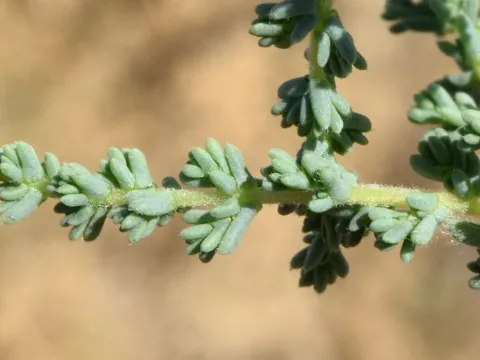
Salsola dendroides
Salsola dendroides
Salsola dendroides is a perennial shrub species belonging to the Amaranthaceae family, highly valued for its ability to survive in harsh saline environments. Sowing is typically performed in late autumn, allowing the seeds to undergo natural stratification in the soil throughout the winter months.
What the section contains
Salsola dendroides
In regions with milder climates, early spring sowing is feasible once the soil temperature is sufficient for germination. Seeds should be planted at a shallow depth of 1–2 centimeters, ensuring firm contact with the soil to promote efficient moisture absorption.
Cultivation for pasture establishment is usually done in rows with wide spacing, which allows the root system to expand and develop fully. It is crucial to ensure the planting field is cleared of invasive weeds in the early stages, as the plant grows slowly during its initial period of establishment.
Seed rates vary depending on the intended use and the desired density of the stand. In arid or desert regions, broadcasting or aerial seeding on prepared soil is often employed to mimic the natural dispersal patterns, which is both cost-effective and highly efficient.
After sowing, light compaction of the soil is recommended to retain moisture in the surface layer. Proper soil management during the germination phase significantly improves survival rates, especially in areas where supplemental irrigation is not available or practical.
The plant has high light requirements and thrives in open, sunny environments. As a characteristic halophyte, Salsola dendroides is uniquely adapted to soils with high concentrations of water-soluble salts, where most common agricultural crops would fail to grow.
Salsola dendroides exhibits exceptional drought tolerance, utilizing a deep taproot system to access subterranean water. This biological trait makes it an ideal candidate for erosion control and land reclamation in arid and semi-arid regions prone to desertification.
Soil requirements are focused on good aeration, as the plant can handle high salinity but is sensitive to prolonged waterlogging. It performs best on loamy or sandy soils with mineral enrichment, avoiding areas where surface water collects for extended periods.
The temperature regime is marked by a strong adaptation to continental climates, with the ability to withstand scorching summers and cold winters. Its shrubby structure provides the necessary durability to endure temperature extremes and persistent dry winds without significant tissue damage.
Agronomic management is minimal, requiring little to no chemical fertilization due to the plant's efficiency in nutrient uptake from poor, saline substrates. Tillage should be kept to a minimum to maintain soil structure and prevent potential wind-induced erosion of the topsoil.
The agricultural value of Salsola dendroides lies in its role as a source of green biomass during autumn and winter, a period when other forage plants are dormant. Yields depend heavily on annual precipitation patterns and the density of the shrub population on the plot.
Under favorable conditions, the plant produces significant annual biomass rich in minerals and protein. This makes it an essential component of the forage diet for camels, sheep, and goats, particularly in desert or semi-desert pastoral systems.
With careful grazing rotation, these stands can maintain high productivity for several decades. Controlled foraging encourages branching and rejuvenation of the shoots, which in turn optimizes the total biomass output of the plantation over the long term.
In land reclamation projects, yield is measured by the plant's ability to cover the soil surface and stabilize moving sands. These areas provide ecological stability and prevent topsoil loss, which is far more valuable than immediate forage output in certain environmental contexts.
Maximizing yield involves balancing the harvest frequency with the plant's natural regeneration rate. Efficient use of the biomass ensures that the plantation remains a reliable food source while continuing to provide essential ecosystem services in sensitive regions.
Diseases affecting Salsola dendroides are rare in natural conditions. Occasional occurrences of fungal infections, such as rust or powdery mildew, may appear during abnormally humid weather, but these rarely cause large-scale damage to established plantations.
Pests are primarily limited to insects that target generative organs, which can affect seed production. Damage to the woody stems is uncommon, as the plant's dense structure acts as a natural physical barrier against most wood-boring pests found in arid zones.
The most significant threat is human-induced overgrazing, which can degrade the plant community and lead to severe soil compaction. Uncontrolled livestock pressure prevents the shrub from regenerating, eventually leading to the loss of the stand and soil depletion.
While some lepidopteran larvae may feed on the foliage, the plant’s high regenerative capacity allows it to withstand and recover from such herbivory. Most pest management in these areas relies on maintaining the natural balance rather than using chemical pesticides.
Field monitoring should focus on identifying signs of severe overgrazing or localized pest outbreaks. Adjusting grazing schedules allows the plant to recover and prevents the long-term decline of the forage crop, maintaining the stability of the entire pasture ecosystem.
Harvesting Salsola dendroides is primarily achieved through direct grazing by livestock, which is the most natural and economically sustainable method for utilizing this biomass in pastoral agriculture.
For hay production, mechanized harvesting is performed at the peak of seed maturity. This timing ensures that the gathered biomass is at its peak nutritional value, capturing both the green leaf material and the nutrient-rich seed components.
Drying the harvested biomass is done in the field under natural sunlight, leveraging the low atmospheric humidity typical of the plant's habitat. Once the material reaches appropriate moisture levels, it is baled or stored in stacks for later use during the winter season.
Seed collection is usually carried out in late autumn when the fruits are fully ripe and ready to disperse. Properly harvested seeds should be cleaned and stored in cool, dry conditions to ensure high germination potential for the subsequent planting season.
Sustainability is key during any harvesting operation. It is essential to leave a portion of the plants undisturbed to facilitate natural reseeding, ensuring the persistence of the plantation without the need for frequent, costly re-seeding cycles.