
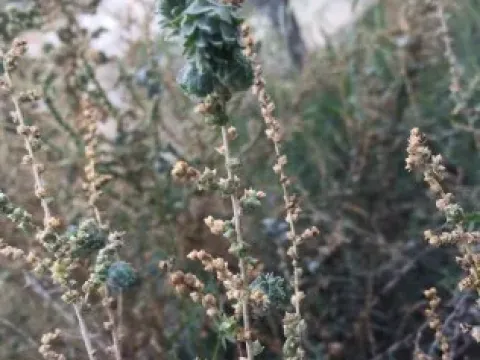
Salsola boissieri
Salsola boissieri
Salsola boissieri is a distinctive plant belonging to the Amaranthaceae family, known for its extreme tolerance to saline and arid environmental conditions.
What the section contains
Salsola boissieri
The native habitat includes desert and semi-desert regions of the Middle East and Mediterranean, where it occupies niches that are hostile to conventional crops.
Botanically, this species is classified as a halophyte, possessing specialized morphological adaptations to thrive in high-salinity soil environments without nutrient stress.
Soil requirements are relatively specific: it prefers well-drained, sandy, or stony substrates with high salt concentrations where other competitors are naturally suppressed.
The plant demonstrates remarkable climate adaptability, thriving under intense solar radiation and successfully managing water loss through advanced transpiration regulation mechanisms.
The primary agricultural utility of Salsola boissieri lies in its role as a vital forage resource for livestock production in desert and arid zones.
It remains palatable and nutritionally valuable during the dry season, providing essential minerals and roughage when other pasture grasses have dried out.
Due to its deep root system, the plant serves as a critical component in land restoration projects, preventing soil erosion and stabilizing desert dunes.
Sustainability in grazing systems is enhanced by the plant's natural regeneration capability, allowing it to recover effectively after seasonal grazing pressure.
In terms of production, the species provides a consistent supply of biomass even under severe climatic stress, ensuring its importance for food security in fragile ecosystems.