
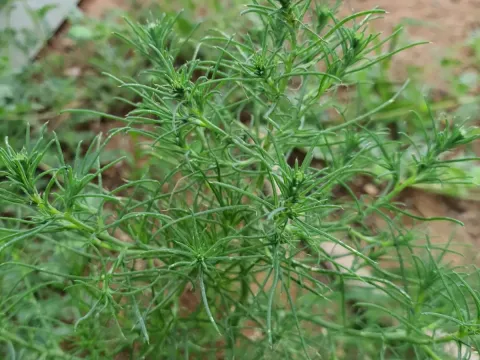
Salsola collina
Salsola collina
Seeds of Salsola collina are sown in early spring as soon as the soil warms up to 5–8 degrees Celsius, as the crop is highly cold-tolerant during germination.
What the section contains
Salsola collina
To ensure uniform emergence, pre-stratification of seeds is recommended, which significantly improves field germination rates and initial seedling vigor.
The seeding rate varies from 5 to 8 kg per hectare depending on soil conditions, with planting depth limited to 1–2 centimeters to prevent seed failure.
Sowing is carried out in rows with a spacing of 30–45 centimeters, which facilitates subsequent weeding and maintenance of young crops.
Post-sowing rolling of the soil is mandatory to ensure firm seed-to-soil contact and to preserve capillary moisture in the upper soil layers.
Salsola collina is a typical halophyte with a unique ability to grow on saline, sodic, and sandy soils where other common crops would fail.
The plant is extremely light-demanding and does not tolerate shading, so cultivation sites must be completely open and well-ventilated.
The crop is characterized by outstanding drought tolerance, making it an excellent candidate for land reclamation and greening of arid and degraded areas.
The optimal pH range for active growth is from slightly alkaline to strongly alkaline soils, and the plant handles chloride-type salinity well.
During the vegetation period, the plant requires almost no supplemental irrigation due to its well-developed root system capable of extracting deep soil moisture.
The yield of green biomass of Salsola collina under favorable conditions can reach 150 to 250 centners per hectare, depending on management intensity.
When harvesting for seed production, yields range from 5 to 8 centners per hectare, though care must be taken to prevent over-ripening and subsequent seed shedding.
Maximum productivity is achieved in fields with sufficient available nitrogen, despite the plant's general adaptability to low-fertility conditions.
The dry matter content is approximately 20–25 percent of the total green biomass, which is a competitive metric for forage crops of this family.
Crop stability largely depends on the timely removal of competing weeds during the early developmental phase before the crop rows close.
Primary pests for Salsola collina include various species of weevils that may damage the apical meristem during the early vegetative stage.
Crops may be susceptible to powdery mildew under conditions of prolonged moisture stagnation or abnormally high humidity, leading to premature leaf yellowing.
Aphids can colonize shoot tips, significantly reducing the market quality of medicinal raw materials and slowing down biomass accumulation rates.
Root rots occur extremely rarely, usually manifesting only in sites with heavy clay soils and poor drainage that causes waterlogging.
To prevent the spread of diseases, it is necessary to practice crop rotation and avoid overcrowding of plantings, which minimizes the risk of pathogen development.
Harvesting green biomass for medicinal purposes is conducted during the full flowering phase, when the concentration of active compounds is at its peak.
For seed collection, harvesting begins when the lower seeds turn dark, using separate harvesting methods to minimize potential harvest losses.
The cut biomass must be quickly dried in the shade or in specialized dryers at temperatures not exceeding 45 degrees Celsius to preserve biological activity.
When used as forage, harvesting should occur before the stems become woody to ensure higher palatability and better nutritional value for livestock.
After the harvest, the field should be deep-disked to incorporate crop residues, which serve as an excellent source of organic matter for saline soils.