
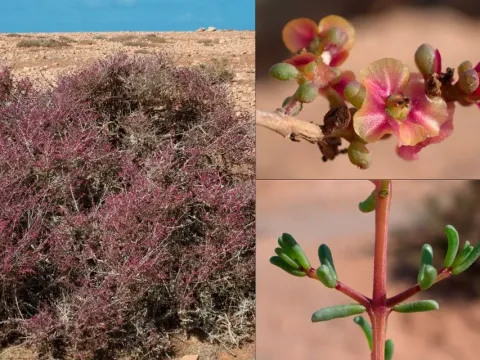
Salsola gymnomaschala
Salsola gymnomaschala
Salsola gymnomaschala is a plant species belonging to the Amaranthaceae family, known for its extreme resilience in arid and saline environments.
What the section contains
Salsola gymnomaschala
As a true halophyte, this species thrives in soils with high salt concentrations where traditional agricultural crops fail to establish or produce significant biomass.
The plant is native to desert and semi-desert regions, showing an remarkable adaptation to high solar radiation and severe water scarcity throughout the growing season.
Its morphological features, including succulent-like structures, allow it to efficiently manage water retention, which is critical for its survival in harsh, alkaline environments.
The species plays a vital role in restoring degraded lands and preventing soil erosion in arid zones, making it an essential component of sustainable land management in desert regions.
The optimal time for sowing Salsola gymnomaschala is early spring, which maximizes the utilization of residual winter soil moisture for germination.
Seeds should be placed at a shallow depth of 1-2 cm, as they possess small reserves and require proximity to the surface to successfully emerge under field conditions.
Surface rolling after planting is a standard agricultural practice for this crop to improve seed-to-soil contact and encourage uniform germination across the field.
Seed preparation, including cleaning and removing the perianth, is highly recommended to improve flowability during mechanical planting and ensure higher seedling vigor.
The seeding rate is typically managed based on the specific site conditions, generally ranging from 5 to 9 kg/ha, aiming to achieve a density that prevents weed invasion.
The plant exhibits high natural resistance to common fungal and bacterial diseases that plague most commercial forage crops, thanks to its specific physiological salt-tolerance.
Insect pests, particularly locusts or specific coleopterans, can occasionally damage young vegetative tissues, requiring monitoring during the sensitive early developmental stages.
Overgrazing poses the greatest threat to the stability of Salsola gymnomaschala populations, as it depletes the plant's resources for regrowth and promotes soil exposure.
Maintaining a rational grazing schedule is the primary defense strategy, ensuring that the plants are not overstressed and remain productive throughout the growing season.
Competitive weeds are generally not a major issue in highly saline environments where the crop has a selective advantage, but they should be controlled if the crop is grown in better soils.
Harvesting for forage is best conducted at the full flowering stage to ensure a balance between biomass quantity and the nutritional quality of the dried forage.
Mowing should be performed at a height of approximately 10-15 cm to protect the crown of the plant, which is crucial for subsequent regeneration of the stand.
Post-harvest management involves careful drying in windrows, preventing excessive nutrient loss caused by leaf shattering, which is common in many dry-land species.
For seed production, direct combining is the preferred method when the seeds reach full maturity and display the characteristic darkening associated with peak viability.
Storage requires low humidity conditions, as the seeds of Salsola gymnomaschala can easily lose their germination capacity if exposed to moisture during the off-season.