
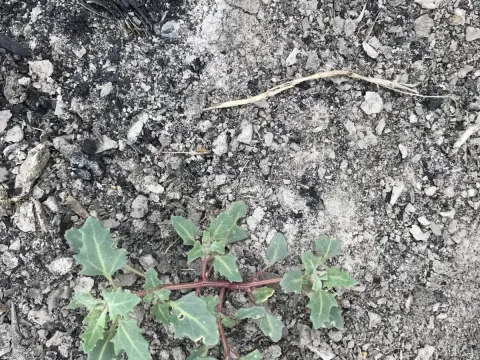
Saline saltbush
Chenopodium salinum
Saline saltbush, known scientifically as Chenopodium salinum, is an annual herb belonging to the Amaranthaceae family. It is a highly specialized halophyte that thrives in environments where soil salinity levels exceed the survival threshold for most traditional crops.
What the section contains
Saline saltbush
Its natural range includes arid and semi-arid regions across North America and Eurasia. The plant is commonly found on the margins of salt lakes, salt pans, and irrigated agricultural fields that have suffered from secondary salinization.
The botanical structure is adapted for extreme conditions, featuring fleshy, mealy-covered leaves that assist in moisture retention. These structural adaptations allow the plant to maintain cellular function despite high osmotic stress caused by elevated concentrations of salts in the soil profile.
Regarding soil requirements, this species prefers alkaline soils and exhibits a remarkable ability to extract minerals from saline substrates. It does not require high nitrogen levels, instead prioritizing survival mechanisms that protect its metabolic processes from ion toxicity.
In terms of agricultural use, Chenopodium salinum is increasingly viewed as a model plant for researching salt-tolerance genes. By understanding how this species manages ion compartmentalization, researchers aim to improve the salt tolerance of essential cereal and vegetable crops.
The plant is susceptible to fungal pathogens such as powdery mildew, especially in regions with fluctuating humidity levels. These infections can severely impact the plant's overall biomass and successful seed maturation cycles.
Insect pests, including aphids and leaf miners, frequently target the succulent foliage of the saline saltbush. These pests can weaken the plant, making it more vulnerable to secondary infections or severe desiccation during prolonged heat waves.
When occurring within agricultural systems, Chenopodium salinum can act as a persistent weed. Its presence serves as a clear indicator of soil salinity issues that may require immediate management, such as improved drainage or gypsum application.
Control strategies often involve a combination of mechanical tilling and deep cultivation to suppress weed germination. Due to the waxy leaf cuticle, contact herbicides are often ineffective, necessitating a more integrated approach to weed management in affected areas.
Despite these threats, the resilience of the species is exceptionally high. Its ability to produce a large number of seeds ensures that it persists in harsh habitats where other flora cannot compete, making it a permanent feature of salty ecosystems.