
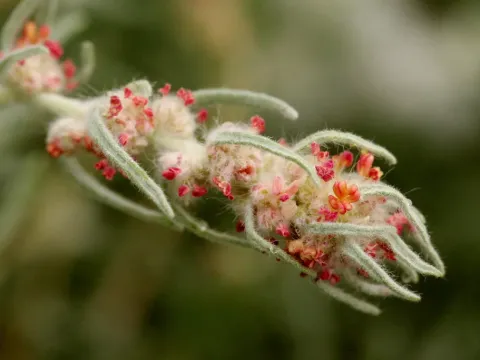
Winterfat
Krascheninnikovia
Sowing of Winterfat is best performed in the late autumn or early spring to take advantage of natural soil moisture cycles.
What the section contains

Winterfat
The seeds require firm contact with the soil and sufficient moisture to germinate effectively, although they are highly resilient.
The optimal planting depth is 1 to 2 centimeters; deeper sowing significantly reduces the emergence rate of the seedlings.
Row spacing should be maintained between 60 and 70 centimeters to minimize competition for nutrients during the establishment year.
Since the plants grow slowly during their first season, controlling invasive weeds is essential for successful stand establishment.
Winterfat (Krascheninnikovia) is a member of the Amaranthaceae family, perfectly adapted to arid and semi-arid environments worldwide.
It thrives in full sunlight and requires open areas with no shading to maintain its characteristic growth habit and productivity.
The plant demonstrates remarkable tolerance to alkaline, saline, and rocky soils where other traditional forage crops would fail to survive.
Excellent soil drainage is critical, as stagnant water is the primary cause of root-related stress and potential disease outbreaks.
Its deep taproot system allows it to access water deep within the soil profile, providing survival capabilities during severe dry seasons.
The biomass yield of Winterfat depends heavily on local environmental conditions and the overall health of the rangeland or field.
Under optimal conditions, dry matter yields can reach up to 5–8 quintals per hectare, depending on the stand age and precipitation.
The nutritional profile remains exceptionally high, providing protein-rich forage even during late autumn and early winter months.
Regrowth capacity is moderate, and sustainable management requires rotational grazing to ensure the plants recover sufficiently between harvests.
Productivity typically stabilizes between the third and fifth years, provided the stand is managed to prevent overgrazing.
Winterfat is naturally resistant to many pests and diseases, which is a major advantage for low-input agricultural systems.
Insect pests are mostly restricted to the flowering stage, where they may occasionally damage seeds if populations are uncontrolled.
Root rot is rarely an issue unless the soil remains waterlogged, which should be mitigated through proper site selection.
Integrated pest management strategies are advised, focusing on biological controls whenever possible to maintain ecological balance.
General stand health is best maintained by ensuring proper aeration and avoiding excessive fertilization, especially with nitrogen.
Seed harvesting should occur when the fruits are fully mature and show a characteristic change in color to prevent premature shattering.
Mechanical harvesting requires careful adjustment of equipment to prevent excessive seed loss during the transition from the field.
For forage production, grazing or mowing should be timed to avoid depleting the plant's carbohydrate reserves before winter dormancy.
Hay harvest is most productive when the plants are in the early flowering stage, ensuring a balance between biomass quantity and quality.
Post-harvest processing involves cleaning and drying the seeds to ensure they remain viable and free from moisture during storage.