
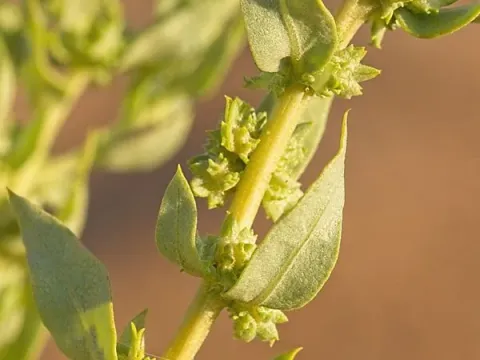
Five-stamen orach
Atriplex pentandra
Five-stamen orach, known scientifically as Atriplex pentandra, is an annual herbaceous crop belonging to the Amaranthaceae family. Planting typically occurs in the spring when soil temperatures reach stable, favorable levels for germination.
What the section contains
Five-stamen orach
The optimal sowing period is usually in mid-spring, ensuring the seeds are placed in sufficiently moist soil to facilitate quick emergence.
Preparation of the seedbed is essential, requiring a fine-textured soil that encourages consistent contact between the seeds and the underlying substrate.
Seeds are sown at a shallow depth of approximately 1–2 centimeters, which is ideal for the small seed size of this species.
For agricultural purposes, planting in rows is recommended to allow for efficient mechanical weeding and nutrient application throughout the growing season.
This crop is highly valued for its tolerance to saline soils, making it an excellent candidate for agricultural production on lands where standard crops struggle to grow.
Five-stamen orach is a sun-loving plant that achieves its highest biomass production when grown in open fields with minimal shading from surrounding vegetation.
Water requirements are moderate; the plant features an efficient root system that allows it to survive intermittent dry spells without significant loss of productivity.
The soil structure should preferably be well-drained, with sandy or loamy textures supporting the best overall health and structural integrity of the plant.
It thrives in temperature ranges of 20–25 degrees Celsius and exhibits strong resilience against the temperature fluctuations common in arid climates.
The overall yield of green biomass depends significantly on the initial plant density and the availability of essential nitrogen nutrients during the peak growth phase.
When managed under intensive conditions, including adequate moisture supply, the plant can produce significant amounts of forage material.
Harvesters should monitor the plant closely to avoid losing yield to natural seed shattering, which is a common characteristic of this species at full maturity.
Average yield metrics highlight the plant's potential as a productive forage source, especially in environments where alternative crops are not viable.
To maximize the nutrient quality for animal feed, harvesting must be timed according to the growth stage rather than the total bulk weight alone.
Typical pests affecting five-stamen orach include various species of weevils and flea beetles, which primarily damage the foliage during the seedling stage.
In humid conditions, powdery mildew can become a concern, necessitating appropriate monitoring and potential use of preventive fungal treatments.
Aphid colonies may develop on the upper shoots during hot weather, potentially weakening the plant and impacting its photosynthetic capacity.
Effective weed control is critical during the first few weeks of growth to ensure the plant establishes a strong canopy without unnecessary competition.
A structured crop rotation plan helps minimize the buildup of soil-borne pathogens and contributes to the overall stability of the farming system.
For forage production, the crop should be harvested during the budding phase to ensure the highest protein concentration and nutritional value for livestock.
Seed harvesting is conducted using specialized machinery once the seeds reach physiological maturity and the plant begins to show signs of senescence.
The green mass should be processed quickly after harvest, as high moisture content in the tissues can lead to spoilage if not dried properly.
Using mowers with conditioning features can significantly improve the drying process for hay production, resulting in a superior final forage product.
Proper scheduling based on weather forecasts is essential to ensure a successful harvest and to preserve the quality of the raw material collected.