
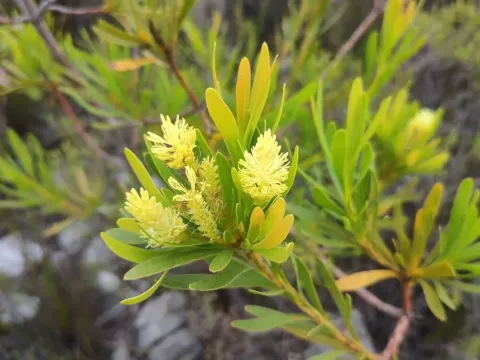
Aulax
Aulax Berg
Propagation of Aulax is primarily achieved through seeds or semi-hardwood cuttings. Seeds are sown in a well-draining, sand-peat substrate in late summer or early autumn, mimicking the natural seasonal cycles found in South Africa.
What the section contains
Aulax
To ensure successful germination, it is crucial to maintain a specific temperature regime, featuring cool nights and moderate daytime temperatures. Many agronomists recommend smoke treatment or specific stimulants to promote germination in Proteaceae species.
Cuttings should be taken in professional greenhouses equipped with bottom heating systems to facilitate rapid root development. The optimal time for taking cuttings is during the plant's active growth dormancy, when stems are sufficiently firm.
Once true leaves appear, seedlings are transplanted into individual containers filled with a high-porosity mix containing perlite or coarse sand. Providing intense lighting is essential to prevent leggy growth in young specimens.
Transplanting to a permanent location or larger pots must be performed with extreme care, as the root system of Aulax is highly sensitive to mechanical damage and waterlogging.
Aulax is a genus of shrubs within the Proteaceae family, natively found exclusively in the Cape Floristic Region of South Africa. These plants are uniquely adapted to climates characterized by dry summers and wet winters.
The primary soil requirement is low nutrient content, particularly low phosphorus, which can be toxic to members of this family. The growing medium must have an acidic pH and exceptional air permeability.
The plant is highly photophilous and requires placement in areas with full sun exposure throughout the day. In greenhouse environments, forced ventilation is mandatory to prevent overheating and maintain optimal humidity levels.
Irrigation must be moderate and strictly monitored. In its natural habitat, Aulax is accustomed to seasonal droughts, so excessive soil moisture leads to immediate root rot and plant mortality.
The climate for cultivation should resemble Mediterranean conditions, where there is no risk of frost. Aulax does not tolerate freezing temperatures, so it is grown exclusively in containers or conservatory settings in colder climates.
The primary commercial use of Aulax is within the floral design and landscaping industries. Its flower heads possess significant ornamental value, making them highly sought after for exotic bouquets and artistic arrangements.
Harvesting is conducted during the semi-blooming phase when the flowers best retain their freshness and turgor. To extend the vase life, stems should be immediately submerged in clean water treated with appropriate floral preservatives.
The plant responds well to pruning, which helps stimulate the growth of new flowering shoots. Pruning should be carried out immediately after the flowering season ends to remove spent blooms and damaged wood.
Commercial plantation management requires meticulous monitoring of each shrub's health, as the slow growth rate makes rapid investment returns challenging.
Finished floral products must be transported under strict temperature control to prevent overheating and moisture condensation, which can lead to rapid fungal growth on the petals.
The greatest threat to Aulax is posed by soil-borne pathogens, such as fungi of the Phytophthora genus. These organisms attack the root collar when drainage is inadequate, making the infection nearly impossible to cure.
In greenhouse settings, the plant is susceptible to infestations of spider mites and mealybugs. These pests multiply rapidly if ventilation is poor or if the air becomes excessively dry.
Poor airflow often results in the development of powdery mildew on young leaves, which significantly diminishes the plant's marketability. Regular preventative inspections are the cornerstone of plantation health management.
Iron deficiency or micronutrient imbalances, often caused by incorrect soil pH, manifest as leaf chlorosis. While not an infectious disease, this condition significantly weakens the plant's natural resistance to other threats.
- Phytophthora root rot caused by waterlogging
- Powdery mildew in stagnant air
- Spider mites in hot, dry environments
- Mealybugs on stems
- Chlorosis due to improper soil acidity