
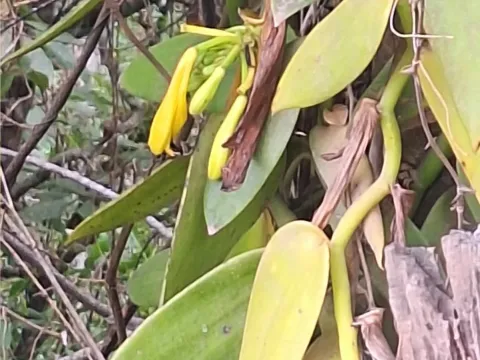
Vanilla
Vanilla
Vanilla is a perennial vine belonging to the Orchidaceae family. In commercial agriculture, propagation is primarily performed via stem cuttings ranging from 50 to 100 cm in length.
What the section contains
 Hybrid Vanilla
Hybrids between Vanilla planifolia and Vanilla tahitensis
Hybrid Vanilla
Hybrids between Vanilla planifolia and Vanilla tahitensis
 Hybrids between Vanilla planifolia and Vanilla odorata
Hybrids between Vanilla planifolia and Vanilla odorata
Hybrids between Vanilla planifolia and Vanilla odorata
 Hybrids between Vanilla planifolia and Vanilla pompona
Hybrids of Vanilla planifolia and Vanilla bahiana
Hybrids between Vanilla planifolia and Vanilla bahiana
Hybrids between Vanilla planifolia and Vanilla pompona
Hybrids between Vanilla planifolia and Vanilla pompona
Hybrids of Vanilla planifolia and Vanilla bahiana
Hybrids between Vanilla planifolia and Vanilla bahiana
 Tahitian vanilla
Vanilla tahitensis J. W. Moore
Tahitian vanilla
Vanilla tahitensis J. W. Moore
 Vanilla bahiana
 Hoehne
Vanilla bahiana
Vanilla bahiana Hoehne
 Vanilla odorata
 C. Presl
Vanilla odorata
Vanilla odorata C. Presl
 Vanilla phaeantha
 Rchb. f.
Vanilla phaeantha
Vanilla phaeantha Rchb. f.
 Vanilla planifolia
 Jacks.
Vanilla planifolia
Vanilla planifolia Jacks.
 Vanilla planifolia x Vanilla phaeantha hybrid
Hybrids between Vanilla planifolia and Vanilla phaeantha
Vanilla planifolia x Vanilla phaeantha hybrid
Hybrids between Vanilla planifolia and Vanilla phaeantha
 Vanilla pompona
 Schiede
Vanilla pompona
Vanilla pompona Schiede
Vanilla
Cuttings are planted at the beginning of the rainy season to ensure optimal rooting. They are usually placed in well-drained soil or substrate and tied to vertical supports, such as trees or stakes.
Growing vanilla from seeds is rarely practiced commercially due to the complexity of germination, which requires specific symbiotic fungi present in native soil environments.
Proper shade management is essential during the early stages of plant growth, as young vines are susceptible to extreme heat and direct solar radiation.
The planting density typically ranges between 1,500 and 2,500 plants per hectare, allowing enough space for manual care and the labor-intensive pollination process.
Vanilla is a tropical crop that thrives in temperatures between 20°C and 30°C. Stable, warm conditions are crucial for consistent growth and high-quality pod production.
The plant requires high humidity levels, ideally maintained between 70% and 80%. Frequent irrigation is necessary in regions with distinct dry seasons to prevent plant stress.
Soils must be loose, rich in organic matter, and possess excellent drainage to prevent root rot. Heavy clay soils are generally unsuitable without significant amendments.
Filtered sunlight or moderate shading is required for healthy foliage development. Direct, intense sunlight can cause leaf scorch and damage the plant's delicate vascular system.
A mild, cool period is often necessary to trigger the flowering response, making the choice of growing site altitude and climate zone a key factor for successful cultivation.
The first pods are generally produced 3 to 4 years after planting, with full production capacity typically reached between the 5th and 7th year of the plantation's life cycle.
Because natural pollinators like Melipona bees are often absent, hand-pollination is required for every individual flower to ensure fruit set and high yields.
An average plantation can yield between 500 and 1,000 kg of cured vanilla pods per hectare, depending on the intensity of management and soil fertility levels.
Proper vine pruning and training are essential to optimize the distribution of flowers and to ensure that energy is directed toward pod development rather than vegetative growth.
Yield stability depends on consistent organic fertilization and the maintenance of soil structure to support the shallow root system of the vanilla vine.
Fusarium root rot is the most significant threat to vanilla plantations, often thriving in waterlogged soils with poor aeration. It can destroy entire sections of a plantation rapidly.
Anthracnose is a fungal disease that affects both leaves and maturing pods. It causes necrotic lesions that decrease the market value and quality of the final cured product.
Insect pests, including mealybugs and spider mites, are common in drier climates. They cause damage by feeding on plant sap and spreading secondary viral or bacterial infections.
Effective management includes maintaining strict sanitation, isolating infected plants, and ensuring tools used for pollination are disinfected between different plants.
- Fusarium root rot
- Anthracnose
- Mealybugs
- Spider mites
Harvesting vanilla is a highly specialized skill. Pods are hand-picked individually as they reach physiological maturity, identified by the yellowing of the pod tip.
Since the flowers on a single inflorescence bloom over several weeks, the harvest must be carried out over a period of months, requiring multiple passes through the plantation.
Once harvested, the pods undergo a complex curing process involving heating, sweating, and slow drying to develop the characteristic vanilla aroma and dark color.
The final cured product must have a specific moisture content and flexibility. High-quality pods often develop a frost-like coating of vanillin crystals on the surface.
Proper post-harvest management is as critical as the cultivation itself, as poor processing can render high-quality pods worthless in the gourmet spice market.