
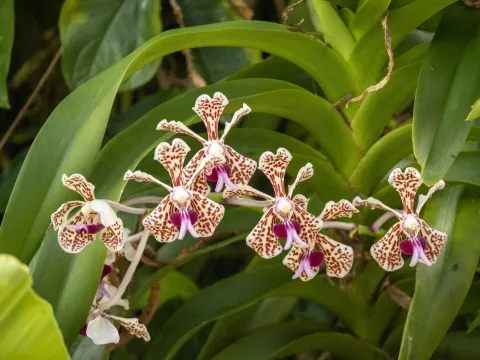
Vanda
Vanda
Vanda is a genus of highly ornamental epiphytic plants belonging to the Orchidaceae family. Native to tropical regions of Southeast Asia, these plants have evolved to survive in environments with high humidity and significant rainfall, typically clinging to tree branches in forest canopies.
What the section contains
 Blue Vanda
Vanda coerulea
Blue Vanda
Vanda coerulea
 Vanda alpina
Vanda arbuthnotiana
Vanda arbuthnotiana
Vanda alpina
Vanda alpina
Vanda arbuthnotiana
Vanda arbuthnotiana
 Vanda arcuata
Vanda arcuata
Vanda arcuata
 Vanda bicolor
Vanda bicolor
Vanda bicolor
 Vanda coerulescens
Vanda caerulescens
Vanda coerulescens
Vanda caerulescens
 Vanda concolor
Vanda concolor
Vanda concolor
 Vanda dearei
Vanda dearei
Vanda dearei
 Vanda denisoniana
Vanda denisoniana
Vanda denisoniana
 Vanda devoogtii
Vanda devoogtii
Vanda devoogtii
 Vanda hastifera
Vanda hastifera
Vanda hastifera
 Vanda helvola
Vanda helvola
Vanda helvola
 Vanda hybrid
s
Vanda hybrid
Vanda hybrids
 Vanda insignis
Vanda insignis
Vanda insignis
 Vanda lamellata
Vanda lamellata
Vanda lamellata
 Vanda lombokensis
Vanda lombokensis
Vanda lombokensis
 Vanda luzonica
Vanda luzonica
Vanda luzonica
 Vanda merrillii
Vanda merrillii
Vanda merrillii
 Vanda miniata
Vanda miniata
Vanda miniata
 Vanda parishii
Vanda parishii
Vanda parishii
 Vanda pumila
Vanda pumila
Vanda pumila
 Vanda sanderiana
Vanda sanderiana
Vanda sanderiana
 Vanda scandens
Vanda scandens
Vanda scandens
 Vanda sumatrana
Vanda sumatrana
Vanda sumatrana
 Vanda tesselata
Vanda tesselata
Vanda tesselata
 Vanda thwaitesii
Vanda thwaitesii
Vanda thwaitesii
 Vanda tricolor
Vanda tricolor
Vanda tricolor
 Vanda ustii
Vanda ustii
Vanda ustii
 Vanda vietnamica
Vanda vietnamica
Vanda vietnamica
Vanda
The botanical structure of the Vanda is distinct due to its monopodial growth habit and robust, aerial root system. The roots are covered in a thick layer of velamen, which acts as a sponge, rapidly absorbing moisture and dissolved nutrients from the surrounding atmosphere.
Optimal cultivation requires a warm climate with temperatures consistently between 20°C and 30°C. Maintaining high atmospheric humidity (70-80%) is essential, as the plant relies on its roots to collect moisture from the air rather than a soil-based medium.
In commercial agriculture, Vanda is typically grown in hanging baskets or open wooden slats without substrate. This method ensures maximum airflow around the root zone, which is vital for preventing the root rot commonly caused by dampness in conventional containers.
Lighting is the most significant factor for consistent flowering. These orchids require high-intensity, bright, but indirect sunlight. In large-scale greenhouse production, shading systems are used to modulate light levels and prevent thermal damage to the leaves during peak radiation hours.
Common pests affecting Vanda include mealybugs, scale insects, and spider mites. These pests thrive in stagnant air conditions. Regular monitoring of leaf axils and the use of insecticidal soaps or systemic treatments are standard protocols for pest management.
Fungal pathogens such as Fusarium and Phytophthora pose a significant threat, especially when humidity is high and airflow is restricted. These infections often target the root system, causing decay that can rapidly progress to the crown of the plant.
Bacterial soft rot is a severe condition that can destroy a Vanda plant in a matter of days if water accumulates in the growing tip or leaf axils. Prevention centers on ensuring the plants are dry by nightfall and providing constant air movement.
Thrips are particularly problematic during the flowering season, as they feed on delicate buds and petals. Their feeding causes unsightly scarring and may lead to premature flower drop, significantly reducing the commercial value of the crop.
Leaf spotting, often resulting from improper fertilization or temperature stress, can detract from the plant's health and appearance. Using a balanced, low-salt fertilizer regime helps maintain the plant's physiological resistance to environmental fluctuations.