
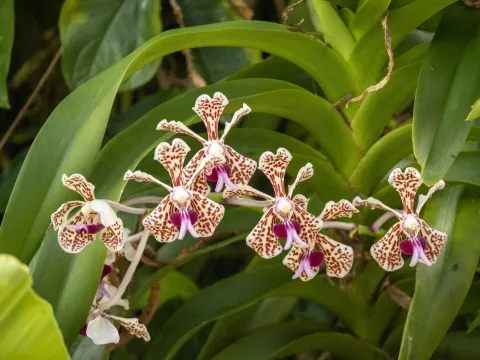
Vanda
Vanda Jones ex R. Br.
Vanda is a genus of perennial epiphytic plants belonging to the Orchidaceae family. Naturally occurring in tropical Asia, these plants are known for their aerial roots, which absorb moisture and nutrients directly from the humid tropical atmosphere.
What the section contains
 Vanda ampullacea
 (Roxb.) L. M. Gardiner
Vanda ampullacea
Vanda ampullacea (Roxb.) L. M. Gardiner
 Vanda coerulescens
 Griff.
Vanda coerulescens
Vanda coerulescens Griff.
 Vanda curvifolia
 (Lindl.) L. M. Gardiner
Vanda curvifolia
Vanda curvifolia (Lindl.) L. M. Gardiner
 Vanda falcata
 (Thunb.) Beer
Vanda falcata
Vanda falcata (Thunb.) Beer
 Vanda falcata x Vanda ampullacea
hybrids between Vanda falcata (Thunb.) Beer and Vanda ampullacea (Roxb.) L. M. Gardiner
Vanda falcata x Vanda ampullacea
hybrids between Vanda falcata (Thunb.) Beer and Vanda ampullacea (Roxb.) L. M. Gardiner
 Vanda falcata x Vanda coerulescens hybrid
hybrids between Vanda falcata (Thunb.) Beer and Vanda coerulescens Griff.
Vanda falcata x Vanda coerulescens hybrid
hybrids between Vanda falcata (Thunb.) Beer and Vanda coerulescens Griff.
 Vanda falcata x Vanda curvifolia
hybrids between Vanda falcata (Thunb.) Beer and Vanda curvifolia (Lindl.) L. M. Gardiner
Vanda falcata x Vanda curvifolia
hybrids between Vanda falcata (Thunb.) Beer and Vanda curvifolia (Lindl.) L. M. Gardiner
Vanda
Botanically, Vanda plants are characterized by their monopodial growth habit. They possess thick, fleshy roots covered in velamen, an adaptive tissue that allows them to store water and survive in high-canopy environments without direct contact with soil.
In commercial agrotechnics, Vanda is cultivated without traditional substrates. They are typically housed in hanging baskets, which facilitate the necessary air movement around the root system and prevent anaerobic conditions that lead to root rot.
The climate requirements for high-yield production are strict: high relative humidity (70–80%) and temperatures ranging from 25°C to 30°C. Maintaining these parameters consistently is vital for preventing physiological disorders and ensuring vegetative vigor.
Photosynthetic requirements are high; Vanda orchids are considered high-light plants. In greenhouse environments, supplementary lighting is often required to meet the light intensity needs, which directly impacts the frequency and quality of flowering.
Pest management is a primary concern in Vanda production, with spider mites and scale insects being the most prevalent threats. These pests penetrate the velamen, leading to dehydration and weakening of the plant's structural integrity.
Bacterial soft rot is a significant pathological threat, often triggered by water accumulation in leaf axils during periods of low temperature or poor ventilation. This condition progresses rapidly and can destroy a plant within days.
Fungal diseases, including Fusarium and Anthracnose, typically manifest when irrigation practices involve contaminated water sources. Proper filtration and pH balance of irrigation water are essential for maintaining plant health.
Viral infections, such as Cymbidium Mosaic Virus, pose a systemic risk. Because there is no cure, management strategies focus entirely on sanitation, including the sterilization of tools and the isolation of symptomatic plants to maintain the health of the crop.
Integrated pest management (IPM) protocols are standard, focusing on biological controls where possible, supplemented by chemical applications to ensure the crop remains marketable and healthy throughout its growth cycle.