
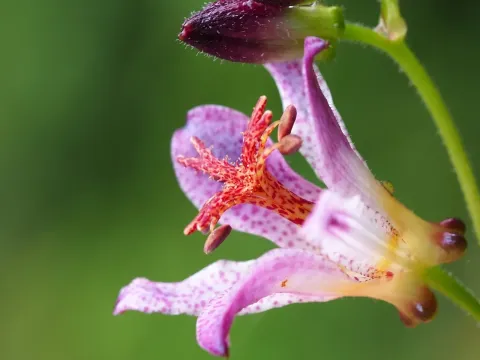
Tricyrtis
Tricyrtis Wall.
Tricyrtis, commonly known as the toad lily, belongs to the Liliaceae family. It is a genus of herbaceous perennial plants native to the forest edges and shady slopes of East Asia, primarily distributed across Japan, China, and the Himalayas.
What the section contains


Tricyrtis
The culture thrives in partial to full shade, mimicking its natural woodland habitat. Direct sunlight, especially during the peak of summer, can scorch the foliage and significantly reduce the overall health and ornamental value of the plant.
To succeed in cultivation, gardeners must provide soil that is rich in organic matter, consistently moist, yet well-drained. The pH level should ideally be neutral or slightly acidic to support optimal nutrient uptake for these herbaceous perennials.
Morphologically, Tricyrtis is characterized by upright or arching stems that carry alternate, often spotted leaves. The root system consists of creeping rhizomes, which allow the plant to spread slowly and form attractive clumps in suitable garden environments.
The most distinctive feature of the toad lily is its complex, orchid-like flowers. These appear in late summer or autumn and feature unique patterns of purple or brown spots on a lighter background, adding significant late-season interest to shade gardens.
While generally hardy, Tricyrtis is susceptible to fungal issues if grown in waterlogged soils. Ensuring excellent drainage is the most effective preventative measure against root rot, which is the primary cause of plant failure in this species.
Pest management focuses largely on slugs and snails. These creatures are particularly attracted to the tender shoots and leaves of the toad lily during damp conditions, necessitating the use of barriers, traps, or molluscicides to protect the aesthetic integrity of the foliage.