
Cotyledon orbiculata
Cotyledon orbiculata var. oblonga (Haw.) DC.
Description
Growing requirements
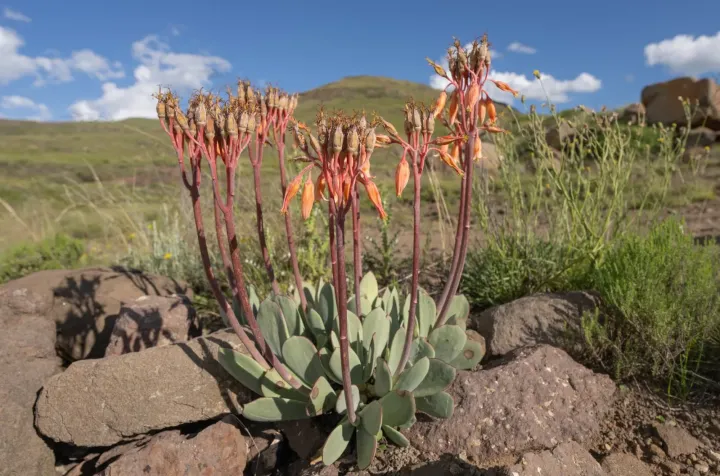
Cotyledon orbiculata (specifically the variety oblonga) is a prominent member of the Crassulaceae family. It is a slow-growing succulent native to the arid landscapes of South Africa, characterized by its fleshy, often powdery leaves designed to survive harsh, drought-prone environments.
The culture thrives under high-intensity light conditions. To maintain its compact structure and vibrant leaf pigmentation, it requires exposure to bright, direct sunlight for most of the day, making it an excellent candidate for sunny windowsills or greenhouse environments.
The substrate must be highly porous and inorganic-heavy to ensure rapid drainage. A mix comprising coarse sand, grit, and standard cactus soil is essential. Poorly draining soil will inevitably lead to root hypoxia and subsequent death of the specimen.
Temperature management is critical for the success of this crop. While it tolerates a range of warm temperatures during its growing season, it requires a distinct cooling period during winter (ideally between 10°C and 15°C) to simulate its natural dormant cycle.
Irrigation should follow a strict "soak and dry" cycle. In warmer months, water only when the substrate has completely dehydrated. During winter, watering should be reduced to a bare minimum, just enough to prevent the leaves from shriveling excessively.
Main diseases and pests
Common pests affecting Cotyledon orbiculata include mealybugs, which hide in the tight spaces between leaves and at the base of the plant. They thrive in dry, warm environments and can quickly infest a collection if not treated immediately.
Fungal pathogens represent the most significant threat to the health of the plant. Root rot, caused by various species of fungi, is typically a result of overwatering, especially when the ambient temperature is too low for the plant to transpire efficiently.
Scale insects can also infest the stems of the plant, drawing sap and leaving behind wounds that serve as entry points for secondary infections. Routine visual inspections are the most effective method for early detection and mitigation.
To prevent disease outbreaks, keep the foliage dry at all times. If water must be applied, do it directly to the soil surface to prevent the accumulation of moisture in the leaf axils, which often triggers rot.
Should the plant become infected with rot, isolate it immediately from other succulents. Cut away all mushy, brown tissue until clean, firm tissue remains, allow the cuts to callus for several days, and repot in fresh, dry soil.