
Hybrid of Cotyledon orbiculata and Cotyledon papillaris
hybrids between Cotyledon orbiculata L. var. oblonga (Haw.) DC. and Cotyledon papillaris L. f.
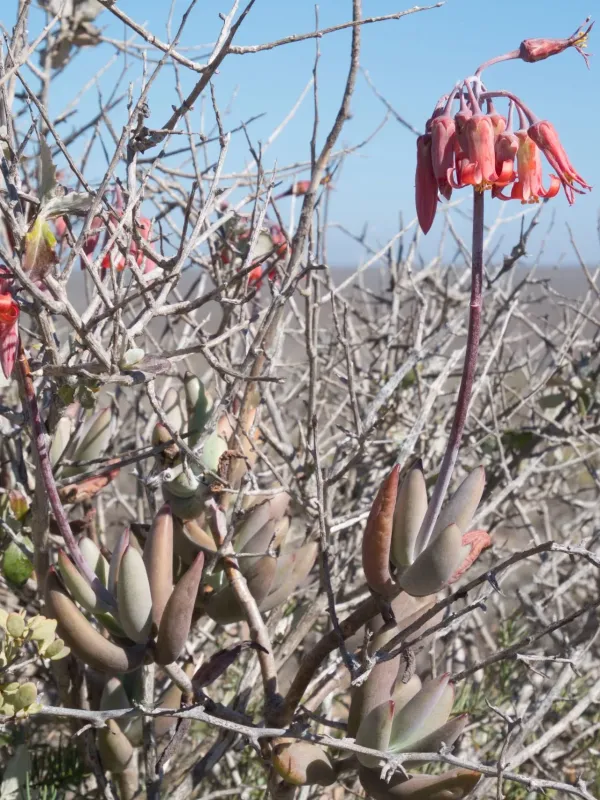
Description
Growing requirements
This hybrid belongs to the Crassulaceae family and is a perennial succulent plant that combines the morphological traits of both parent species. For successful development, it requires bright, indirect light to prevent stem elongation.
The plant demonstrates high adaptability to climatic conditions typical of semi-arid regions, although in cultivation, it is critical to maintain a moderate temperature range without sharp fluctuations during the winter season.
The growing medium must have excellent drainage properties, as moisture stagnation is fatal to the root system of this species. An ideal mix consists of loam, coarse sand, and perlite in a 1:2:1 ratio.
Watering should be done by soaking the soil ball as it dries out completely, mimicking the natural precipitation cycles of the plants' native Southern Africa.
During the growing season, the crop requires specialized fertilizer for succulents with low nitrogen content, which helps strengthen cell walls and water storage in the leaves.
Main diseases and pests
The main threat to the hybrid is root rot, resulting from improper watering schedules and the use of overly dense substrate lacking sufficient aeration.
In greenhouses or indoors, the plant may be infested by mealybugs, which settle in leaf axils and suck cell sap, weakening the plant's overall vigor.
Spider mites are common pests in conditions of low humidity, making regular preventive checks of the underside of leaves mandatory for population control.
If signs of decay appear, immediate repotting is necessary, involving the removal of damaged root sections and treatment with systemic fungicides.
To prevent the spread of pests, it is recommended to quarantine new specimens and periodically wipe the leaves with a damp cloth to remove accumulated dust.