
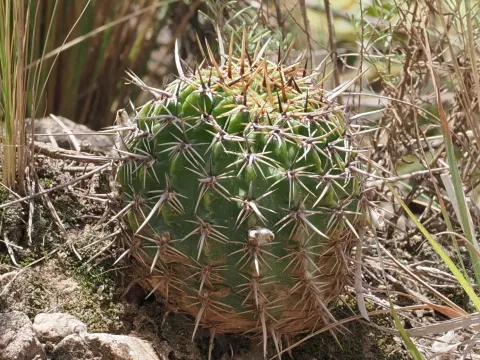
Golden Echinopsis
Echinopsis aurea
The Golden Echinopsis (Echinopsis aurea) is a perennial succulent species belonging to the Cactaceae family. It is native to the northern regions of Argentina, primarily found in Cordoba and Salta provinces, where it thrives in rocky, well-drained alpine environments.
What the section contains
Golden Echinopsis
Botanically, this species is defined by its globose stem which may become cylindrical over time, reaching sizes of up to 10 centimeters in diameter. It is known for its prominent ribs adorned with golden or brownish spines, which serve as an adaptation to intense high-altitude solar radiation.
Regarding soil requirements, this plant demands an extremely porous and gritty substrate to mimic its native rocky habitat. A standard cactus mix fortified with additional pumice or perlite is essential to ensure rapid drainage, as the species is highly susceptible to root damage in stagnant, water-logged conditions.
The cultivation of this plant relies heavily on light exposure. To induce its characteristic golden-yellow flowering, the plant requires several hours of direct sunlight daily during the growing season. Lack of sufficient light often results in etiolation, a state where the stem grows thin and loses its natural form.
During the winter dormancy period, the plant requires a cool, dry climate with temperatures maintained between 8°C and 12°C. This cooling phase is critical for the plant's metabolic regulation and is a mandatory prerequisite for the development of flower buds in the following spring cycle.
The primary threats to Echinopsis aurea are fungal pathogens, specifically those causing basal rot. These are almost always a result of overwatering or poor ventilation within the growing environment, which creates a favorable breeding ground for opportunistic microbes.
Common pests that plague this species include spider mites, which thrive in dry indoor air, and mealybugs that congregate in the crevices of the ribs. Integrated pest management using systemic insecticides and increasing humidity levels moderately around the plant can effectively mitigate these biological threats.