
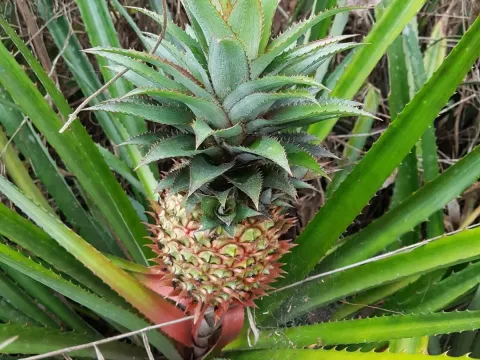
Pineapple
Ananas Mill.
Pineapple (Ananas Mill.) is a perennial herbaceous plant belonging to the Bromeliaceae family. In commercial agricultural practice, propagation is performed almost exclusively through vegetative methods, as modern cultivated varieties typically do not produce seeds.
What the section contains


Pineapple
Commonly used planting materials include slips (suckers arising from the peduncle), suckers (arising from the stem), and crowns (the leafy tuft at the top of the fruit). Choosing high-quality, disease-free suckers or crowns is critical for ensuring uniform crop development.
Planting is executed in well-drained, porous soil to prevent root asphyxiation. In intensive plantation systems, a double-row planting pattern is standard, optimizing plant density while allowing enough space for field maintenance and harvest access.
It is essential to allow the planting material to cure (dry out) for several days before placement in the soil. This prevents rot at the cut site and reduces the incidence of soil-borne pathogens attacking the base of the plant.
Once planted, the focus shifts to root development. Consistent moisture levels, combined with warm soil temperatures, ensure that the plant establishes itself quickly, providing a foundation for future fruit production.
As a tropical crop, the pineapple requires warm temperatures, ideally between 24°C and 30°C. Prolonged exposure to temperatures below 10°C will significantly stall growth and can cause physiological damage to the foliage and fruit.
The crop thrives in acidic soils with a pH range of 4.5 to 5.5. Soil with poor drainage or high clay content is unsuitable, as it promotes root rot and limits nutrient uptake, particularly iron and manganese.
While pineapple is drought-tolerant due to its CAM metabolism, it requires consistent water availability for optimal fruit size. Excessive water or poorly drained fields are the primary causes of plantation failure.
Nutrient management involves precise application of NPK fertilizers, with a strong focus on potassium, which directly influences fruit quality, sweetness, and shelf life. Micronutrient sprays are often used to correct localized deficiencies.
In modern operations, flower induction is managed through the application of ethylene-releasing chemicals. This practice allows for precise scheduling of the harvest, ensuring that the fruit reaches the market in consistent quantities.
A well-managed pineapple plantation can yield between 70 to 90 metric tons per hectare. Yield is heavily dependent on plant density, variety selection, and the effectiveness of the vegetative management program.
The time from planting to the first harvest typically ranges from 14 to 18 months. After the main fruit is harvested, the plant is often managed to produce a second crop, known as the ratoon crop, which arises from side suckers.
Ratoon crops usually require lower initial investment costs, making them a common strategy for increasing the overall economic profitability of a pineapple farm over several years.
Fruit quality is assessed based on mass, sugar content (Brix), and flesh firmness. Breeders prioritize varieties that resist bruising, as fruit damage during transport significantly reduces profitability for export-oriented businesses.
Success in commercial yield relies on minimizing the gap between physiological maturity and harvest time, ensuring that the fruit retains its sensory characteristics during long-distance shipping.
Heart rot, caused by the oomycete Phytophthora parasitica, is one of the most severe diseases in pineapple farming. It thrives in waterlogged conditions and can devastate entire production blocks if left unmanaged.
Mealybugs (Pseudococcidae) are significant pests not only because they feed on the plant sap, but also because they act as vectors for the mealybug wilt-associated virus, which causes severe crop decline.
Root-knot nematodes (Meloidogyne spp.) attack the root system, causing gall formation. This damage prevents the plant from absorbing necessary nutrients and water, leading to stunted growth and yellowing of the leaves.
Effective management includes integrated pest management (IPM) strategies, such as using nematode-free planting stock, proper soil aeration, and the strategic application of insecticides when pest thresholds are reached.
Field sanitation is vital to prevent disease outbreaks. Removing and destroying infected plant material promptly helps maintain the health of the surrounding crop and slows the spread of infectious agents.
Pineapple harvesting is a labor-intensive manual process. Because pineapples are non-climacteric, they do not ripen further once removed from the plant, making the timing of the harvest of paramount importance.
Workers assess maturity by checking the skin color change and the intensity of the fruit aroma. Picking the fruit too early results in poor sweetness, while picking too late makes the fruit highly susceptible to transit damage.
The fruit is cut from the stalk, taking care to leave the crown intact for the fresh market. After harvest, the fruit should be handled carefully to avoid impact bruises, which lead to rapid decay.
Post-harvest treatment often involves washing and applying food-grade wax to enhance appearance and provide a physical barrier against desiccation and minor fungal pathogens during transit.
Cold chain management is essential for long-distance logistics. Keeping the fruit at optimal storage temperatures slows down respiratory processes and helps maintain freshness until it reaches the final consumer.