
Ananas macrodontes
Ananas macrodontes E. Morren
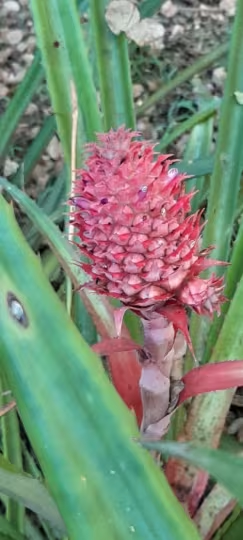
Description
Growing requirements
Ananas macrodontes belongs to the Bromeliaceae family. It is a perennial herbaceous plant that differs significantly from the common edible pineapple, primarily due to its specialized industrial application rather than fruit production.
This species is native to the tropical regions of South America. In its natural habitat, it grows in humid forests and open plains of Brazil, Paraguay, and Argentina, favoring stable environmental conditions throughout the year.
The crop has specific temperature requirements: it is highly sensitive to frost and thrives at average temperatures between 20–25°C. Optimal growth is achieved under conditions of high air humidity and consistent rainfall patterns.
Regarding soil conditions, the plant is moderately demanding, preferring light, well-drained substrates with acidic or neutral pH levels. Waterlogging around the roots is a critical risk factor that promotes rot and decay.
The plant features a robust leaf rosette with long, prickly-edged leaves. These fibrous leaves are the primary asset of the culture, as they contain high-quality textile fiber known for its remarkable strength and durability.
Yield
The primary use of Ananas macrodontes is the extraction of strong technical fiber, which outperforms many synthetic alternatives in specific applications. It is utilized in the production of fishing nets, ropes, and specialized industrial fabrics.
Green biomass yield depends directly on planting density and the intensity of cultural practices. By adhering to standardized agronomic protocols, significant volumes of raw fiber material can be harvested from a single hectare.
The yield of pure fiber represents a small percentage of total leaf mass, making primary processing a crucial phase of production. The extraction efficiency depends on the maturity stage of the plant and the decortication methods employed.
The economic value of this species is attributed to the fiber's ability to withstand prolonged moisture exposure without losing structural integrity. This makes the plant a promising crop for regions with suitable tropical climates.
The crop holds potential for industrial cultivation within agroforestry systems, where it serves as a reliable source of fiber and a tool for preventing soil erosion on sloping terrains.
Main diseases and pests
Like many members of the Bromeliaceae family, Ananas macrodontes can be susceptible to various root rots if irrigation practices are not properly managed. Excessive soil moisture is the primary risk factor for root health.
Among pests, the greatest threat comes from mealybugs and scale insects, which can multiply rapidly within the leaf axils. They feed on plant sap, weakening the host and facilitating the development of sooty mold.
In large-scale industrial farming, regular phytosanitary monitoring is essential. If infestations are detected, systemic insecticides that comply with local agricultural safety standards should be applied promptly.
Disease prevention strategies include using high-quality planting material and maintaining proper spacing between rows to ensure adequate airflow. Dense planting patterns create a microclimate that favors pathogen development.
- Regular inspection of the base of the leaf rosettes.
- Removal of dead or infected leaves to prevent the spread of disease.
- Monitoring soil and air moisture during prolonged rainy seasons.