
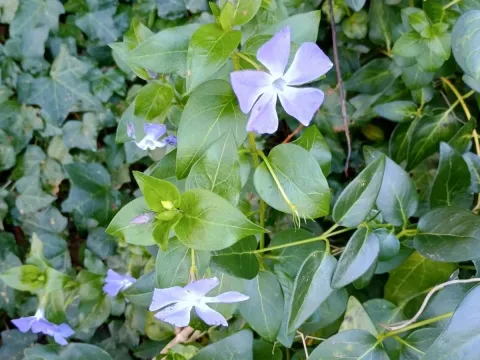
Periwinkle
Vinca L.
Periwinkle (genus Vinca L.) is a group of perennial herbaceous plants or subshrubs belonging to the Apocynaceae family. Native to Europe, North Africa, and Western Asia, these plants are renowned for their trailing growth habit and evergreen foliage.
What the section contains


Periwinkle
The crop thrives in fertile, well-drained soils with a pH ranging from neutral to slightly acidic. Vinca species are highly adaptable, exhibiting excellent shade tolerance while maintaining growth in partially sunlit environments, provided they receive sufficient hydration.
Botanically, the periwinkle is characterized by its creeping stems that readily root at the nodes. This trait allows the plant to form dense, mat-like ground cover that suppresses weeds and helps prevent soil erosion on sloping terrains.
Agricultural management for periwinkle is relatively straightforward, focusing primarily on initial establishment and weed control. Once the plant has formed a thick carpet, it requires minimal intervention, though periodic trimming is recommended to maintain the desired area.
Economically, periwinkles are valued in both the ornamental landscaping sector and the pharmaceutical industry. The plants are cultivated as a source of alkaloids, which are extracted for their potent cardiovascular and pharmacological properties.
Like many ground cover species, periwinkle is susceptible to fungal diseases, particularly rust. This pathogen manifests as orange or brown pustules on leaves, which can significantly reduce the photosynthetic capacity and vitality of the stand.
Powdery mildew is another major threat, especially in humid conditions or areas with poor air circulation. It appears as a white powdery layer on the surface of leaves, causing curling and eventual necrosis of the foliage.
Aphids and scale insects represent the most significant pest threats to Vinca crops. By feeding on the sap of young stems, these insects can weaken the plant and serve as vectors for various viral diseases that negatively impact yield.
To maintain plant health, integrated pest management (IPM) strategies should be employed. This includes manual removal of infested stems, proper spacing to ensure airflow, and the use of approved systemic pesticides when necessary.
Root rot, often caused by Phytophthora or Rhizoctonia, can devastate entire plantations if the soil drainage is inadequate. Ensuring that the site is well-drained and avoiding overhead irrigation during damp periods are essential preventive measures.