

Reference · Crops
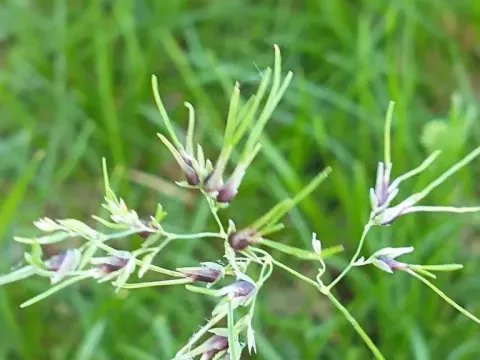
Bluegrass
Poa L.
Bluegrass, belonging to the Poaceae family, is a versatile perennial grass widely valued in agriculture and landscaping. The ideal sowing period is early spring, which provides the necessary moisture for germination.
18
items
What the section contains
 Annual meadow grass
Poa annua L.
28 products
Annual meadow grass
Poa annua L.
28 products
 Rough meadow-grass
Poa trivialis L.
11 products
Rough meadow-grass
Poa trivialis L.
11 products
 Bulbous bluegrass
Poa bulbosa L.
1 product
Bulbous bluegrass
Poa bulbosa L.
1 product
 Alpine meadow-grass
Poa alpina L.
Alpine meadow-grass
Poa alpina L.
 Canada bluegrass
Poa compressa L.
Canada bluegrass
Poa compressa L.
 Coast meadow grass
Poa poiformis
Coast meadow grass
Poa poiformis
 Fowl bluegrass
Poa palustris L.
Fowl bluegrass
Poa palustris L.
 Glaucous bluegrass
Poa glauca Vahl
Glaucous bluegrass
Poa glauca Vahl
 Hybrid of Texas bluegrass and Kentucky bluegrass
Poa arachnifera x P. pratensis
Hybrid of Texas bluegrass and Kentucky bluegrass
Poa arachnifera x P. pratensis
 Kentucky bluegrass
Poa pratensis L.
Kentucky bluegrass
Poa pratensis L.
 Narrow-leaved meadow-grass
Poa pratensis L. subsp. angustifolia (L.) Dumort.
Narrow-leaved meadow-grass
Poa pratensis L. subsp. angustifolia (L.) Dumort.
 Poa ensiformis
 Vickery
Poa ensiformis
Poa ensiformis Vickery
 Poa supina
 Schrad.
Poa supina
Poa supina Schrad.
 Sandberg bluegrass
Poa secunda J. Presl
Sandberg bluegrass
Poa secunda J. Presl
 Texas bluegrass
Poa arachnifera Torr.
Texas bluegrass
Poa arachnifera Torr.
 Tussock Grass
Poa labillardieri C. V. Eskdale
Tussock Grass
Poa labillardieri C. V. Eskdale
 Weak spear grass
Poa imbecilla Spreng.
Weak spear grass
Poa imbecilla Spreng.
 Wood meadow-grass
Poa nemoralis L.
Wood meadow-grass
Poa nemoralis L.
Marketplace
Products in this section · 12


Alfa-Prometrin
Zhejiang Zhongshan Chemical Industry Group Co., Ltd.
Herbicides
1
1
20 offers
4.92 €per pack
Buy

Shogun 100
F.A.GAN Chemical Manufacturers Ltd. Israel, member
Herbicides
1
0
1 offer
96.5 €per pack
Buy


Bluegrass
Autumn sowing is also a viable practice in many regions, allowing the roots to establish before the onset of winter dormancy, leading to stronger growth in the following season.
The seeding rate typically ranges from 10 to 15 kg per hectare, depending on the desired density and the inclusion of other species in a pasture mix.
Because the seeds are extremely small, shallow planting (no deeper than 1–2 cm) is critical. Lightly rolling the soil after sowing ensures good seed-to-soil contact, which increases success rates.
Row planting with 15 cm spacing is standard for forage production, ensuring that the crop can effectively compete with weeds while establishing its root system.
This grass is highly prized for its exceptional winter hardiness and ability to thrive in a wide variety of temperate climate conditions without needing constant replanting.
Bluegrass prefers fertile, well-drained loam soils with a neutral pH. It struggles in extremely acidic or heavily waterlogged soil conditions, which can lead to thinning.
Consistent moisture is a key requirement for healthy growth. While it exhibits some drought tolerance once established, it remains most productive when water is readily available.
Regular nitrogen fertilization is necessary to maintain high forage quality and encourage rapid recovery after grazing or mowing cycles throughout the growing season.
It thrives in open, sunny environments. While it can handle partial shade, significant shading will result in thinner stands and lower overall biomass production.
Bluegrass is known for its reliability and consistency in yield, particularly when managed within a rotational grazing system that allows for regular recovery intervals.
Under optimal conditions, it provides high-quality forage that can be harvested multiple times per season, supporting livestock nutritional needs throughout the year.
Seed production is an important commercial aspect of growing Bluegrass, with yields varying based on the management of soil nutrients and control of environmental stresses.
The nutritional profile of the plant is excellent, offering a good balance of protein and fiber, which makes it a preferred choice for high-performing livestock diets.
Long-term yield stability is one of the greatest benefits of this crop, as it can remain productive for over a decade if properly maintained and fertilized annually.
Rust diseases are among the most common threats to foliage, often appearing in mid-summer and potentially reducing both the appearance and feed value of the grass.
Powdery mildew can affect stands during humid periods, appearing as a white, dusty growth on the leaves that restricts photosynthesis and slows down development.
Insect pests like aphids and various grass-feeding flies can stunt growth by draining essential sap from young tissues, making healthy management crucial.
Wireworms can pose a significant challenge during the establishment phase, as they attack the developing roots and can lead to uneven, patchy field stands.
Integrated pest management, including regular crop monitoring and proper soil preparation, remains the most effective defense against these common agricultural threats.
For high-quality hay production, the harvest should occur during the early heading stage, when the nutrient content in the grass is at its absolute peak.
Grazing management should aim to prevent overgrazing, which allows the plant to preserve its carbohydrate reserves in the root system for faster regrowth after harvests.
Seed harvesting requires precision timing to ensure the seeds have reached physiological maturity but have not yet begun to shatter or fall naturally from the panicles.
Using modern, well-maintained machinery ensures clean cuts and efficient drying, which are vital for preventing mold and preserving the nutritional profile of the harvested hay.
Post-harvest care, such as light harrowing or managed fertilization, helps reinvigorate the stand, ensuring it returns strongly in the next production cycle.