

Reference · Crops
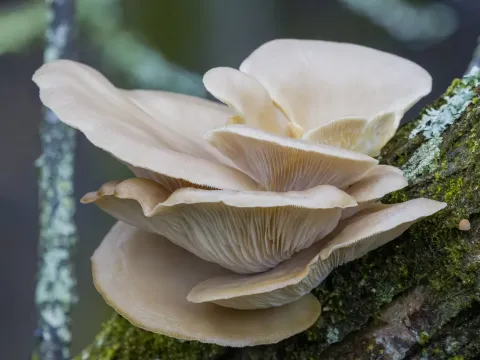
Oyster mushroom
Pleurotus
Oyster mushrooms (Pleurotus) are saprotrophic fungi belonging to the Pleurotaceae family. In nature, they thrive on decaying wood, while commercial cultivation uses various agricultural byproducts.
15
items
What the section contains
 Abalone mushroom
Pleurotus cystidiosus subsp. abalonus
Abalone mushroom
Pleurotus cystidiosus subsp. abalonus
 Branch oyster
Pleurotus cornucopiae (Pers.) Rolland.
Branch oyster
Pleurotus cornucopiae (Pers.) Rolland.
 Florida oyster mushroom
Pleurotus florida
Florida oyster mushroom
Pleurotus florida
 Giant Oyster
Pleurotus giganteus (Berk.) Karun. & K.D. Hyde
Hybrid of King Oyster and Nebrodi Mushroom
hybrids between Pleurotus eryngii (DC.) Quél and Pleurotus nebrodensis (Inzenga) Quél.
Giant Oyster
Pleurotus giganteus (Berk.) Karun. & K.D. Hyde
Hybrid of King Oyster and Nebrodi Mushroom
hybrids between Pleurotus eryngii (DC.) Quél and Pleurotus nebrodensis (Inzenga) Quél.
 Hybrid of King Oyster and Pleurotus tuoliensis
hybrids between Pleurotus eryngii var. ferulae (Lanzi) Sacc and Pleurotus eryngii var. tuoliensis C.J. Mou
Hybrid of King Oyster and Pleurotus tuoliensis
hybrids between Pleurotus eryngii var. ferulae (Lanzi) Sacc and Pleurotus eryngii var. tuoliensis C.J. Mou
 King oyster mushroom
Pleurotus eryngii (DC.) Quél
King trumpet mushroom
Pleurotus eryngii var. ferulae (Lanzi) Sacc
King oyster mushroom
Pleurotus eryngii (DC.) Quél
King trumpet mushroom
Pleurotus eryngii var. ferulae (Lanzi) Sacc
 Oyster mushroom
Pleurotus ostreatus (Jacq.) P. Kumm.
Phoenix mushroom
Pleurotus pulmonarius (Fr.) Quél.
Oyster mushroom
Pleurotus ostreatus (Jacq.) P. Kumm.
Phoenix mushroom
Pleurotus pulmonarius (Fr.) Quél.
 Pink oyster mushroom
Pleurotus djamor (Rumph. ex Fr.) Boedijn 1959
Pleurotus cystidiosus
Pleurotus cystidiosus O.K. Mill.
Pink oyster mushroom
Pleurotus djamor (Rumph. ex Fr.) Boedijn 1959
Pleurotus cystidiosus
Pleurotus cystidiosus O.K. Mill.
 Pleurotus nebrodensis
 (Inzenga) Quél.
Pleurotus nebrodensis
Pleurotus nebrodensis (Inzenga) Quél.
 Pleurotus ostreatus x Pleurotus eryngii hybrid
Pleurotus ostreatus x Pleurotus eryngii
Pleurotus tuoliensis
Pleurotus eryngii var. tuoliensis C.J. Mou
Pleurotus ostreatus x Pleurotus eryngii hybrid
Pleurotus ostreatus x Pleurotus eryngii
Pleurotus tuoliensis
Pleurotus eryngii var. tuoliensis C.J. Mou
Marketplace
Products in this section · 12


Oyster mushroom
The cultivation process begins with the inoculation of a prepared substrate. Common substrates include wheat straw, cottonseed hulls, sunflower seed hulls, and hardwood sawdust, which are sterilized or pasteurized.
Sterilization is critical to eliminate competing molds and bacteria. Once the substrate is cooled, grain spawn is mixed uniformly into the material to allow the mycelium to colonize the medium.
Incubation occurs in a dark, climate-controlled room at approximately 20–24°C. During this phase, the mycelium runs through the substrate, turning the blocks into a dense, white, solid mass.
After colonization is complete, the blocks are transferred to a fruiting chamber where environmental triggers like light and humidity changes initiate the formation of mushroom pins.
Temperature control is essential throughout the lifecycle. During the vegetative stage, temperatures of 20–24°C are ideal, whereas fruiting requires a cooler environment of 12–18°C.
Humidity levels must be strictly maintained between 85% and 90%. Low humidity causes the mushrooms to dry out and develop cracks, while excessive moisture promotes bacterial growth.
Oyster mushrooms are aerobic organisms requiring high oxygen levels. Proper ventilation is needed to ensure the concentration of carbon dioxide (CO2) remains below 0.1% to prevent malformed fruit bodies.
Light is a necessary signal for healthy fruiting. While mushrooms do not perform photosynthesis, 8–12 hours of low-intensity diffuse light per day are needed to ensure proper color and shape.
The substrate pH should be adjusted to be near-neutral. Consistency in these environmental requirements is the key to maintaining a continuous and high-quality production cycle.
Yield is measured by biological efficiency (BE). A typical oyster mushroom crop can achieve a BE of 20–30%, meaning 10 kg of dry substrate can produce 2–3 kg of fresh mushrooms.
Production usually occurs in distinct "flushes" or waves. The first flush is typically the most productive, followed by second and third flushes after short recovery periods for the mycelium.
Nutrient supplementation in the substrate can increase yields significantly. Adding nitrogen-rich materials like wheat bran helps boost the overall harvest weight of the mushroom clusters.
Managing the recovery period between flushes is vital. The mycelium needs to absorb nutrients and recover from the stress of fruit production before it can begin the next flush.
With precise control over climate and substrate quality, producers can achieve high productivity throughout the entire year, optimizing the turnover of the fruiting chambers.
Trichoderma, commonly known as green mold, is the primary threat to oyster mushroom cultivation. It aggressively colonizes the substrate and outcompetes the oyster mushroom mycelium.
Bacterial blotch, caused by Pseudomonas, creates slimy, discolored spots on the caps. This disease is usually a symptom of poor ventilation and excessive surface moisture on the mushrooms.
Fungus gnats and sciarid flies are common pests. They can cause physical damage to the mushrooms and serve as vectors for fungal and bacterial infections within the growing room.
Mites can also infest the substrate, damaging the mycelial network and causing sudden drops in productivity. Integrated pest management, including facility hygiene, is essential for control.
Strict sanitation protocols, including the use of air filtration and proper heat treatment of the substrate, are the best defense against these common biological threats.
Oyster mushrooms are harvested just before the edges of the caps begin to flatten or curl upwards. Harvesting at the right stage ensures better texture and shelf life.
The entire cluster should be removed by cutting or twisting at the base where it attaches to the substrate. It is important to leave no debris behind to prevent the decay of remaining tissue.
Freshly harvested mushrooms are highly perishable and should be cooled to 2–4°C immediately. Cold storage slows down the respiration rate, preserving the quality for commercial distribution.
Packaging should be breathable, such as perforated plastic or cardboard trays. This prevents moisture accumulation and keeps the mushrooms fresh during transit to the retail market.
Daily monitoring of the fruiting room is required for harvesting. Missing the optimal window can lead to spore shedding, which reduces the market value and may cause respiratory irritation for the staff.