


Reference · Crops
Mushroom
Agaricus L.
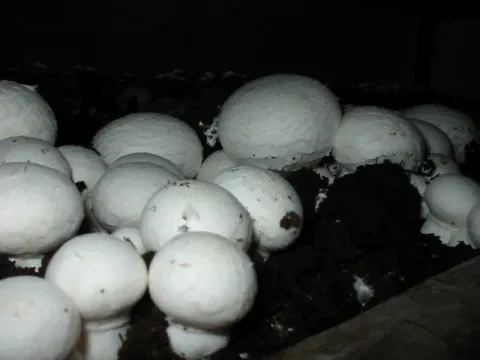
The mushroom (Agaricus L.) belongs to the Agaricaceae family and is one of the most widely cultivated edible fungi globally, relying on saprotrophic nutrition.
5
items
What the section contains
Marketplace
Products in this section · 12


Peat Cover for Cultivating Morels, Fertilizer
АТ «ВОКАС» («WOKAS» S.A.), Польща
Fertilizers
0
0
·
33
1 offer
6.55 €per pack
Buy


Mushroom
The cultivation process begins with inoculation, where high-quality grain spawn is mixed into a pasteurized and fermented organic substrate, usually based on wheat straw and manure.
Following inoculation, the spawn run phase occurs, where the mycelium colonizes the entire substrate volume, typically requiring a dark, temperature-controlled environment for 2-3 weeks.
Once colonization is complete, a casing layer consisting of peat and limestone is applied to stimulate the transition from the vegetative to the reproductive phase.
Efficient mushroom production relies on consistent, year-round cultivation in climate-controlled growing rooms, allowing for a steady flow of fresh harvests regardless of the season.
Mushrooms require specific environmental conditions: during the mycelium colonization phase, temperatures should be maintained between 24-26 degrees Celsius.
After casing, the temperature in the room must be lowered to 16-18 degrees Celsius, and high humidity (85-95%) must be maintained to initiate the growth of the mushroom primordia.
Ventilation is critical to manage CO2 levels; while mycelium growth is tolerant of higher carbon dioxide concentrations, the fruiting stage requires lower levels to ensure healthy development.
The substrate must be formulated to provide sufficient nitrogen and carbon, which are essential for supporting multiple flushes of fruit bodies over the growing cycle.
Light levels are generally not a limiting factor for Agaricus species, though indirect lighting is often provided in facilities to facilitate easier monitoring and management by the staff.
Professional mushroom farms typically achieve yields ranging from 20 to 30 kilograms per square meter of growing area per complete production cycle.
The harvest is produced in several flushes, with the first two flushes usually accounting for the largest portion of the total crop weight during the growing period.
Precise management of water, temperature, and atmospheric gas levels between flushes is vital to maximize yield and ensure the uniformity of subsequent harvests.
Intensive farming uses multi-tier rack systems, which significantly increase the total output per square meter by optimizing vertical space within the growing facility.
By implementing advanced climate control systems, growers can effectively manage the timing of flushes to meet market demand and ensure a consistent supply chain.
Common biological threats include fungal pathogens such as Verticillium (dry bubble disease) and Mycogone (wet bubble disease), which can devastate an entire crop if not managed.
Pests like fungus gnats (Sciaridae) and phorid flies are highly problematic as their larvae feed on both the mycelium and the developing fruit bodies of the mushroom.
Bacterial blotch, caused by Pseudomonas tolaasii, often manifests as brown spots on the caps and is usually linked to excessive moisture or poor air circulation during the fruiting phase.
Rigorous sanitation protocols, including thorough cleaning and disinfection between cycles, are the primary defense against the introduction and spread of diseases and pests.
Integrated Pest Management (IPM) strategies, which include the use of biological controls and strict hygiene measures, are essential to maintain a healthy growing environment.
Mushrooms are harvested by hand using a gentle twisting motion, ensuring that the entire stalk is removed without disturbing the surrounding primordia and the mycelium structure.
Quality control during harvest involves sorting mushrooms by cap size and trimming the stalk to meet specific market standards for uniformity and presentation.
Post-harvest handling is critical, as mushrooms are highly perishable and require immediate cooling to 2-4 degrees Celsius to halt respiration and prevent degradation.
Storage and distribution must occur within a strict temperature-controlled environment to minimize cap browning and maintain the texture and flavor profile of the fresh product.
Logistics are optimized to ensure that the time from harvest to consumer purchase is as short as possible, usually within 48 hours, to guarantee maximum freshness and quality.