
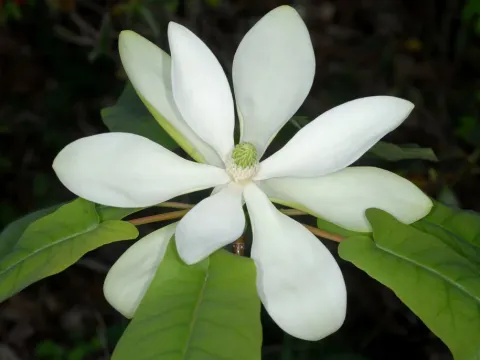
Magnolia
Magnolia L.
Magnolia (Magnolia L.) is a genus belonging to the Magnoliaceae family, encompassing a wide range of flowering trees and shrubs. Known for its aesthetic appeal and pharmacological value, this crop requires specific environmental conditions to reach its full ornamental and growth potential.
What the section contains
 Hybrids of Magnolia x loebneri and Magnolia x soulangeana
hybrids between Magnolia x loebneri Kache and Magnolia x soulangeana Soul.-Bod.
Hybrids of Magnolia x loebneri and Magnolia x soulangeana
hybrids between Magnolia x loebneri Kache and Magnolia x soulangeana Soul.-Bod.
 Kobus magnolia
Magnolia kobus DC.
Kobus magnolia
Magnolia kobus DC.
 Loebner magnolia
Magnolia x loebneri Kache
Loebner magnolia
Magnolia x loebneri Kache
 Magnolia cylindrica
 E. H. Wilson
Magnolia cylindrica
Magnolia cylindrica E. H. Wilson
 Magnolia denudata
 Desr.
Magnolia denudata
Magnolia denudata Desr.
 Magnolia doltsopa
 (Buch.-Ham. ex DC.) Figlar
Magnolia doltsopa
Magnolia doltsopa (Buch.-Ham. ex DC.) Figlar
 Magnolia figo
 (Lour.) DC.
Magnolia figo
Magnolia figo (Lour.) DC.
 Magnolia Foggii
Magnolia x foggii Figlar
Magnolia Foggii
Magnolia x foggii Figlar
 Magnolia insignis
 Wall.
Magnolia insignis
Magnolia insignis Wall.
 Magnolia insignis virginiana
Magnolia insignis x Magnolia virginiana
Magnolia insignis virginiana
Magnolia insignis x Magnolia virginiana
 Magnolia laevifolia
 (Y. W. Law & Y. F. Wu) Noot.
Magnolia laevifolia x Magnolia doltsopa
Magnolia laevifolia x Magnolia doltsopa
Magnolia mediocris
Magnolia mediocris (Dandy) Figlar
Magnolia laevifolia
Magnolia laevifolia (Y. W. Law & Y. F. Wu) Noot.
Magnolia laevifolia x Magnolia doltsopa
Magnolia laevifolia x Magnolia doltsopa
Magnolia mediocris
Magnolia mediocris (Dandy) Figlar
 Magnolia obovata
 Thunb.
Magnolia x soulangeana
Magnolia x soulangeana Soul.-Bod.
Magnolia obovata
Magnolia obovata Thunb.
Magnolia x soulangeana
Magnolia x soulangeana Soul.-Bod.
 Mulan magnolia
Magnolia liliiflora Desr.
Pruhonice Magnolia
Magnolia x pruhoniciana Jakl
Saucer magnolia
Magnolia x soulangeana Soul.-Bod. x Magnolia liliiflora Desr.
Mulan magnolia
Magnolia liliiflora Desr.
Pruhonice Magnolia
Magnolia x pruhoniciana Jakl
Saucer magnolia
Magnolia x soulangeana Soul.-Bod. x Magnolia liliiflora Desr.
 Siebold's magnolia
Magnolia sieboldii K. Koch
Siebold's magnolia
Magnolia sieboldii K. Koch
 Southern magnolia
Magnolia grandiflora L.
Southern magnolia
Magnolia grandiflora L.
 Star magnolia
Magnolia stellata (Siebold & Zucc.) Maxim.
Star magnolia
Magnolia stellata (Siebold & Zucc.) Maxim.
 Sweetbay magnolia
Magnolia virginiana L.
Sweetbay magnolia
Magnolia virginiana L.
 Umbrella magnolia
Magnolia tripetala (L.) L.
Umbrella magnolia
Magnolia tripetala (L.) L.
 Yunnan Hybrid Magnolia
Magnolia yunnanensis x figo
Yunnan Hybrid Magnolia
Magnolia yunnanensis x figo
Magnolia
The plant originates from the regions of East Asia, North America, and parts of South America. Successful cultivation requires a sheltered location with protection from harsh winter winds, which can damage flower buds and young foliage.
Soil quality is paramount; magnolias thrive in slightly acidic, nutrient-rich, and well-draining loamy soils. They are intolerant to alkaline soils, which often induce severe iron chlorosis, limiting the plant's ability to photosynthesize effectively.
Watering strategies must focus on maintaining consistent soil moisture, particularly during the first few years of establishment. Since magnolias have shallow, fleshy root systems, mulch should be applied to prevent moisture evaporation and protect roots from physical damage.
Fertilization is best performed during the spring growth flush. A balanced, slow-release fertilizer tailored for acid-loving ornamental plants is recommended to ensure robust vegetative development without promoting excessive, succulent growth late in the season.
Fungal pathogens such as powdery mildew and leaf spot are common issues in high-humidity climates. Proper air circulation and sanitation, including the removal of infected fallen leaves, are critical preventative measures.
Insect pests include scale insects and aphids, which feed on plant sap and can weaken younger specimens. Targeted insecticide treatments or horticultural oils are recommended once the initial signs of infestation are spotted.
Spider mites frequently attack magnolia foliage during hot, dry summer weather. Keeping the plant hydrated and periodically spraying foliage with water can discourage mite population growth significantly.
Iron chlorosis remains the most common non-parasitic threat. This condition is easily identified by yellowing leaves with dark green veins and is typically managed by acidifying the soil and applying chelated iron treatments.
Winter injury due to sudden temperature drops can cause bark splitting, especially on young trees. Wrapping trunks during extreme cold periods can prevent this stress and protect the tree's vital conductive tissues.