
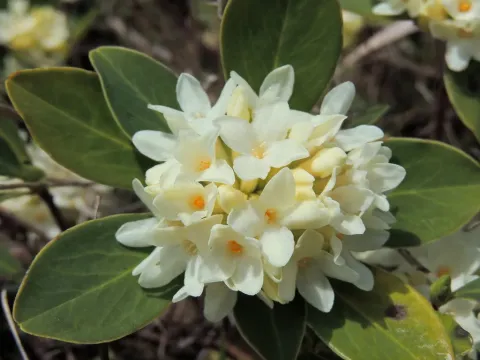
Daphne
Daphne L.
Daphne L. is a genus of deciduous or evergreen shrubs belonging to the Thymelaeaceae family. These plants are primarily native to the temperate and mountainous regions of Eurasia, often found in rocky, cool, and semi-shaded habitats.
What the section contains
 Burkwood daphne
Daphne x burkwoodii Turrill
Burkwood daphne
Daphne x burkwoodii Turrill
 Daphne bholua
 Buch.-Ham. ex D. Don
Daphne bholua
Daphne bholua Buch.-Ham. ex D. Don
 Daphne circassica
 Woronow ex Pobed.
Daphne circassica
Daphne circassica x Daphne sericea
Daphne circassica
Daphne circassica Woronow ex Pobed.
Daphne circassica
Daphne circassica x Daphne sericea
 Daphne hybrid
Hybrids between Daphne bholua and Daphne odora
Daphne hybrid
Hybrids between Daphne bholua and Daphne odora
 Daphne odora
 Thunb.
Daphne odora
Daphne odora Thunb.
 Daphne sericea
 Vahl
Daphne sericea
Daphne sericea Vahl
 Daphne tangutica
 Maxim.
Daphne transatlantica
Daphne x transatlantica C. D. Brickell & A. R. White
Daphne whiteorum
Daphne x whiteorum C. D. Brickell
Daphne x susannae
Daphne x susannae C. D. Brickell
Daphne tangutica
Daphne tangutica Maxim.
Daphne transatlantica
Daphne x transatlantica C. D. Brickell & A. R. White
Daphne whiteorum
Daphne x whiteorum C. D. Brickell
Daphne x susannae
Daphne x susannae C. D. Brickell
 Garland flower
Daphne cneorum L.
Garland flower
Daphne cneorum L.
 Mezereon
Daphne mezereum L.
Neapolitan daphne
Daphne x napolitana hort. Lodd.
Mezereon
Daphne mezereum L.
Neapolitan daphne
Daphne x napolitana hort. Lodd.
 Rock daphne
Daphne petraea Leyb.
Rock daphne
Daphne petraea Leyb.
 Spurge laurel
Daphne laureola L.
Spurge laurel
Daphne laureola L.
Daphne
To cultivate Daphne successfully, it is essential to choose a location with partial shade, as intense midday sun often causes scorching of the foliage. These plants perform best when sheltered from drying winds and harsh exposure.
The soil must be fertile, well-draining, and rich in organic matter. While Daphne prefers moist conditions, it is strictly intolerant of waterlogging, which quickly leads to root decay and the death of the plant.
Temperature management is a key aspect of their care, as many species require a cool dormancy period during winter to thrive in the following season. Proper mulching around the base helps maintain stable soil temperatures and keeps roots cool during summer.
Ornamentally, these plants are highly prized for their early, often highly fragrant spring flowers. Due to the presence of potent toxins throughout the plant, they should be handled with care and kept away from small children and pets.
Aphids frequently target the new, soft growth of Daphne in the spring, which can lead to distorted leaves. Regular monitoring and the application of insecticidal soaps are typically sufficient to manage these infestations effectively.
Botrytis, or grey mold, is a common fungal threat in humid and stagnant environments. Proper air circulation and avoiding overhead watering are the primary cultural methods to prevent this pathogen from spreading.
Leaf spot diseases, caused by various fungi, can occur when foliage remains wet for extended periods. Pruning out infected branches and ensuring the plants are not overcrowded helps to mitigate these issues.
Root rot pathogens, such as Phytophthora, thrive in poorly drained soils and can kill a mature shrub rapidly. The best defense is ensuring a loose, well-aerated soil structure from the time of planting.
While generally robust, virus infections can occasionally cause yellowing or mosaic patterns on leaves. Infected plants usually show stunted growth and should be removed and destroyed to protect nearby healthy specimens.