
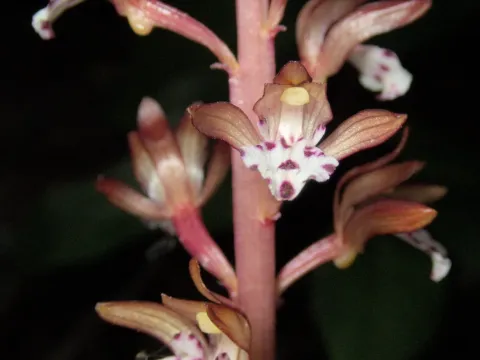
Coralroot
Corallorhiza
Coralroot (genus Corallorhiza) is a group of perennial, leafless orchids belonging to the family Orchidaceae. These plants are non-photosynthetic and rely entirely on a myco-heterotrophic lifestyle, obtaining nutrients through a complex symbiotic relationship with fungi.
What the section contains


Coralroot
Coralroot is not a cultivated agricultural crop. It is found in temperate forest ecosystems across the Northern Hemisphere, where it thrives in shaded areas with high organic content in the soil. It exists as a wild species only.
The name Corallorhiza originates from the plant's distinctive, branched rhizome, which resembles coral structures. Unlike conventional plants, it lacks true roots and chlorophyll, making it completely dependent on its fungal partners for survival.
The species requires a stable forest environment with consistent moisture and undisturbed soil biology. Because of these precise ecological needs, it is impossible to grow this plant in agricultural settings or commercial nurseries.
There are no conventional agronomic practices for Coralroot. Its biological success is tied to the health of forest micro-ecosystems, making it a bioindicator of healthy, undisturbed woodland environments.
The most significant threat to Coralroot is the destruction of old-growth forests and the loss of natural habitat. Any disturbance to the soil, such as logging or road construction, destroys the essential fungal networks the plant requires to survive.
Because it is a non-agricultural plant, it does not deal with standard agricultural pests. However, it is sensitive to environmental stressors such as drastic changes in soil moisture, pollution, or the loss of its specific symbiotic fungal species.
Anthropogenic pressure, including hiking and plant collection, presents a high risk to the plant's delicate population. Many species within this genus are protected by local laws and conservation programs to prevent extinction.
Invasive plant species can pose a threat by altering the nutrient cycle and the fungal composition of the forest floor. These changes often make the environment unsuitable for the highly specialized Coralroot to thrive.
Since Coralroot is not an industrial crop, there are no pest management or control programs. The primary conservation strategy involves the legal protection of natural forest habitats to ensure the long-term survival of the species.