

Pest · Hemiptera (bugs, aphids, leafhoppers) · affects Winter wheat, Common sunflower, Winter rapeseed
Blackberry cereal aphid
Sitobion fragariae
Description
How to identify
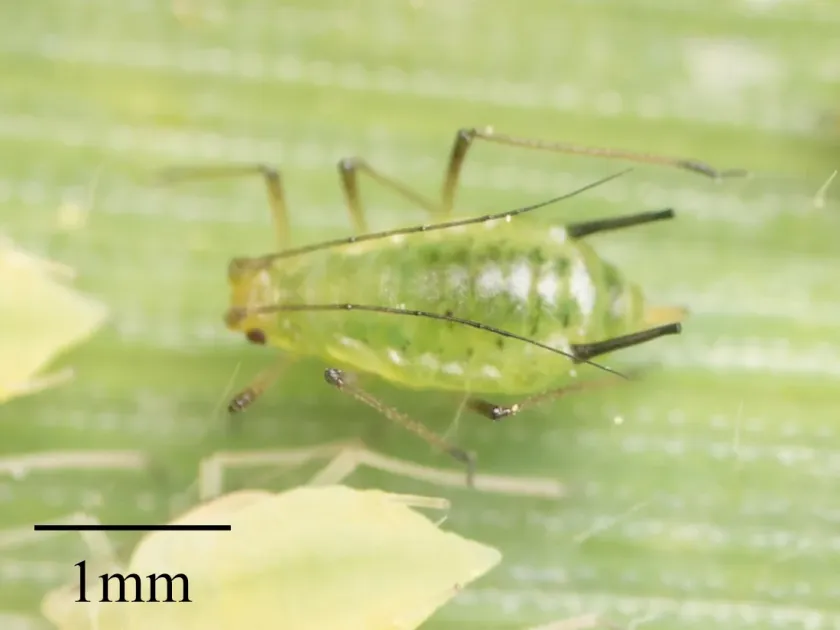
The blackberry cereal aphid (Sitobion fragariae) belongs to the order Hemiptera and the family Aphididae. It is a small insect characterized by an elongated body that varies in color from green to reddish-brown.
A distinctive feature of this species is its long black antennae, which often exceed the length of the body, and well-developed dark cornicles at the end of the abdomen. The legs are also dark, helping to distinguish it from other aphid species found on cereals.
Both winged and wingless forms exist within the population. Winged individuals facilitate the migration of the species over long distances in search of new host plants during the spring and summer months.
The lifecycle of this species is host-alternating. Primary hosts include plants from the Rosaceae family, such as blackberries and strawberries, where overwintering eggs develop.
Secondary hosts include various cereal crops, to which the aphids migrate in late spring. High reproductive rates allow colonies to rapidly colonize large areas of farmland.
What it damages
The main crops damaged by this pest include wheat, barley, oats, and winter rye. The aphids prefer to settle on the ears and the upper leaves of the plants.
Besides cereals, the pest causes significant damage to blackberry and strawberry plantations by sucking sap from young shoots and leaves at the beginning of the growing season.
The economic impact of the aphid lies not only in the direct exhaustion of the plant but also in the transmission of viral diseases, such as barley yellow dwarf virus.
Massive reproduction of aphids leads to a decrease in the photosynthetic activity of the leaves, ultimately resulting in reduced grain yields and poor quality.
Severe infestation of the ears causes the grain to become shriveled and reduces the thousand-grain weight, significantly impacting the commercial output of the farm.
When it appears
The overwintering stage is the egg, which is laid at the base of blackberry shoots or in the leaf axils of strawberries.
In spring, the eggs hatch into stem mothers, which produce several generations before forming winged migrants that fly to cereal fields.
The peak population density on cereals usually occurs during the heading and milk-ripening stages, coinciding with the active grain-filling phase.
During the autumn, a portion of the population migrates back to the primary Rosaceae hosts to lay eggs before the winter dormancy period.
Weather conditions with moderately wet and warm springs favor intense reproduction and rapid population growth of aphid colonies.
Signs of infestation
The first visual sign of infestation is the presence of sticky honeydew on the leaves, which is excreted by the insects while feeding.
Sooty mold often develops on the honeydew, causing the leaves and stems to turn black, which reduces the physiological efficiency of the plant.
When inspecting the ears, one can notice clusters of aphids densely covering the grains, especially on the inner side of the glumes.
Infested plants may show signs of leaf curling, and in cases of high population density, yellowing and premature drying of the vegetation occur.
The presence of large numbers of ants in the field is also an indirect sign of aphid colonies, as ants guard them to feed on their sugary secretions.
Control measures
Effective control starts with agronomic measures, including the destruction of weed plants from the Rosaceae family near fields and shelterbelts.
Crop rotation and maintaining spatial isolation between cereal fields and berry plantations help significantly reduce the risk of mass infestation.
The biological method involves preserving and attracting natural enemies of the aphid, such as ladybirds, lacewings, and predatory hoverflies.
Chemical control is recommended when the economic threshold is exceeded, using systemic or contact-stomach insecticides.
It is crucial to rotate products from different chemical groups to prevent the development of resistance within the pest population to the active ingredients of the insecticides.
Content graph
Connections · Blackberry cereal aphid
Most often together:
Marketplace
Products · 24





Biology
Taxonomy
- Latin name
- Sitobion fragariae
- Order
- Hemiptera (bugs, aphids, leafhoppers)
- Family
- Aphididae
- EPPO code
- MACSFR
Community
Discussion
No discussions yet — be the first.