

Pest · Coleoptera (beetles) · affects Winter rapeseed, Winter wheat, Apple
Especially harmful
Pollen beetle
Brassicogethes aeneus
Description
How to identify
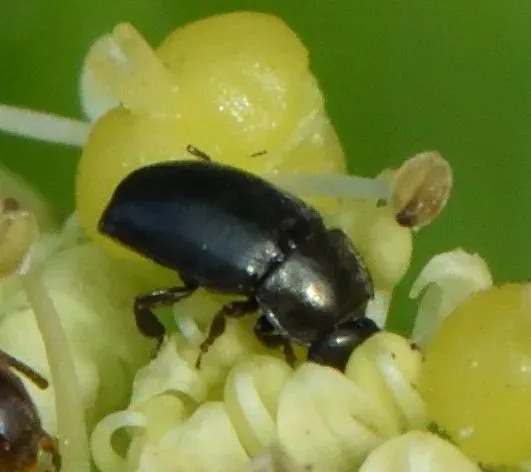
The pollen beetle (lat. Brassicogethes aeneus) is a small beetle belonging to the Nitidulidae family. It is a common pest of cruciferous crops, easily recognized by its metallic green or bronze-black oval-shaped body, which measures about 2 mm in length.
Adult beetles overwinter in the soil or under leaf litter. As spring temperatures rise above 10°C, they emerge from hibernation and begin to feed on the pollen of early-flowering plants before migrating to their primary host crops.
The lifecycle consists of eggs, larvae, pupae, and adults. Female beetles lay their eggs inside small flower buds, providing the hatching larvae with a direct source of food. This internal feeding strategy protects the larvae from many environmental factors.
Larvae are elongated and grayish-white, passing through several stages within the flower bud. After completing their development, they drop to the soil to pupate, usually in the upper layers of the earth, eventually emerging as new adults.
There is typically one generation per year, although favorable warm weather conditions can occasionally lead to a partial second generation. The new generation feeds on pollen during the summer before seeking winter shelter.
What it damages
The pollen beetle primarily targets oilseed rape (canola), cabbage, and other brassica species. The damage occurs when beetles pierce the buds to feed on the pollen inside, leading to bud necrosis and flower abortion.
While the beetle is a specialist on cruciferous plants, it can also feed on a range of other crops under high population pressure, including soybeans, sunflowers, hemp, and even melons or watermelons, though these are not their primary hosts.
Fodder beet might occasionally be visited by the beetles, but the most severe economic losses are consistently reported in oilseed rape production. The damage directly reduces the number of pods formed on the raceme.
The greatest threat occurs during the bud formation stage. If left uncontrolled, a heavy infestation can cause massive crop failure, as the plant sheds its buds, significantly impacting the yield and seed quality of the oilseed crop.
The severity of the damage is often exacerbated by slow crop growth during cool spring weather, which extends the period that the crop remains in the highly susceptible bud stage, allowing the beetles more time to feed.
Signs of infestation
The most obvious sign of an infestation is the presence of numerous small, shiny beetles on the flower buds. Growers should inspect the tops of the racemes, as this is where the beetles congregate to feed.
Damaged buds exhibit small holes where the beetles have entered. Subsequently, these buds turn yellow, shrivel, and eventually fall off, leaving a scarred, empty flower stalk that is easily visible upon closer inspection.
Inside the damaged buds, one can often find the larvae or the remnants of the stamens and pistils consumed by the pests. The presence of larvae is a clear indicator that the infestation has moved to a reproductive phase.
At the field level, damage often appears as uneven flowering or stunted racemes. When infestation levels are high, the visual result is a canopy that appears sparse, with noticeable gaps where flowers should have developed.
Scouting is vital for management. By examining 25 plants across different parts of the field, farmers can determine if the beetle density exceeds the economic threshold, necessitating the use of targeted control measures.
Control measures
Cultural control practices, such as choosing early-maturing varieties, can help the crop progress past the susceptible bud stage before the peak of beetle migration. Additionally, eliminating wild cruciferous weeds around fields reduces overwintering sites.
Chemical control is the standard management technique when the economic threshold is reached. Insecticides belonging to pyrethroid or neonicotinoid classes are commonly used, provided they are applied before the buds open.
It is essential to avoid applying insecticides during the flowering period. This protects vital pollinators like honeybees and other beneficial insects from unnecessary chemical exposure, ensuring ecological balance.
Monitoring using yellow sticky traps or water-filled yellow traps can provide early warning of beetle arrival in the field. This allows for precise timing of chemical applications, increasing their efficacy while minimizing the number of sprays needed.
Integrated Pest Management (IPM) strategies emphasize the combination of crop rotation, field hygiene, and judicious insecticide use. By managing the pest density early in the season, growers can protect the yield potential without compromising environmental safety.
In brief
25
Damages crops
Content graph
Damages crops · 25
Content graph
Connections · Pollen beetle
Most often together:
Marketplace
Products · 4


Biology
Taxonomy
- Latin name
- Brassicogethes aeneus
- Order
- Coleoptera (beetles)
- Family
- Nitidulidae
- EPPO code
- MELIAE
Community
Discussion
No discussions yet — be the first.