
Pollen beetle
Brassicogethes
Description
How to identify
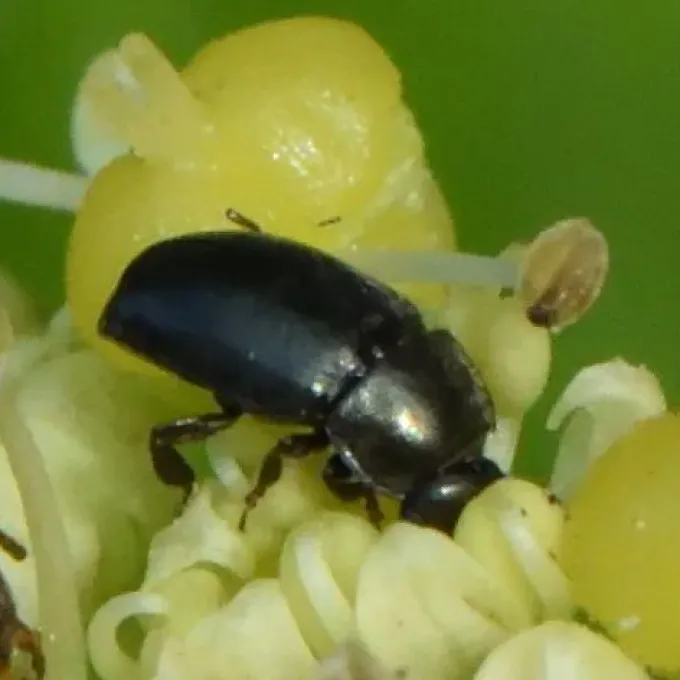
The pollen beetle (Brassicogethes aeneus) is a small, shiny, dark-colored beetle belonging to the family Nitidulidae. Adult beetles are typically 1.5 to 2.7 mm long and display a metallic green or bluish-black appearance, making them distinct from other common brassica pests.
Adults are highly mobile and start migrating to crops as soon as the ambient temperature reaches 10-12 degrees Celsius in early spring. They are attracted to yellow flowers and move rapidly into oilseed rape fields during the crucial bud development stage.
The larvae are whitish, elongated, and reach up to 4 mm in length. They possess small dark plates on their back segments, which serves as a key identification feature. The complete life cycle typically involves one generation per year, though environmental factors can influence the timing of emergence.
Overwintering occurs as adults in the soil, leaf litter, or sheltered areas near hedgerows. Upon emerging, they feed initially on various wild flowers before transitioning to cultivated crops like oilseed rape, mustards, and cabbages once those plants reach a suitable growth stage.
Reproduction takes place on the crop where females lay eggs inside the flower buds. This behavior ensures that the emerging larvae have direct access to the most nutrient-rich parts of the plant, such as pollen and young ovary tissues, which are essential for their survival and development.
What it damages
The primary damage is caused by both adults and larvae feeding on the flower buds. Adults puncture the buds to reach the pollen inside, while larvae consume the internal reproductive organs. This feeding leads to the shriveling and eventual dropping of the buds.
This pest is a major threat to oilseed rape, canola, and other brassica crops. Heavy infestations can cause significant yield reductions, sometimes exceeding 50% if the crop is not protected, particularly in years with prolonged periods of bud development.
The visual signs of damage often include yellowing buds that fail to open and eventually wither away. This results in the characteristic "blind stalks" where the flowers should have been, drastically reducing the number of potential pods and overall seed production.
Plants often attempt to compensate for the damage by producing additional side shoots. However, these shoots typically flower later than the main stem, leading to uneven maturation of the crop, which complicates harvesting and may result in lower seed quality.
Economic damage is most severe when the beetle population density exceeds the established thresholds. Farmers should monitor the crop closely during the green bud stage to determine if chemical intervention is necessary to protect the yield from irreversible losses.
Control measures
Chemical control via insecticides is the most common management strategy. Growers should use approved products from different chemical classes, such as pyrethroids or neonicotinoids, while strictly adhering to safety guidelines to minimize risks to bees and other pollinators.
Integrated Pest Management (IPM) practices, including proper crop rotation, are essential for long-term population control. Moving brassica crops away from previous year's fields reduces the migration of overwintering beetles to new crop areas in early spring.
Field hygiene is a critical component of protection. Managing wild host plants, such as wild mustard and other cruciferous weeds around the field margins, prevents the build-up of beetle populations before the main crop is even ready for colonization.
Selecting vigorous and early-maturing varieties helps the crop pass through the sensitive bud-development stage more quickly. Proper fertilization ensures that plants have enough energy to recover from light grazing or to compensate for lost buds through better branching.
- Deploy yellow water traps to monitor beetle migration and population peaks.
- Apply insecticides during evening hours to protect beneficial pollinating insects.
- Monitor field margins to detect early arrivals of the pest.
- Adopt anti-resistance strategies by alternating active ingredients in insecticide applications.
Taxonomy
- Latin name
- Brassicogethes
- Order
- Coleoptera (beetles)
- Family
- Nitidulidae
- EPPO code
- BRAGSP
Discussion
No discussions yet — be the first.