
Carpophilus antiquus
Carpophilus antiquus
Description
How to identify
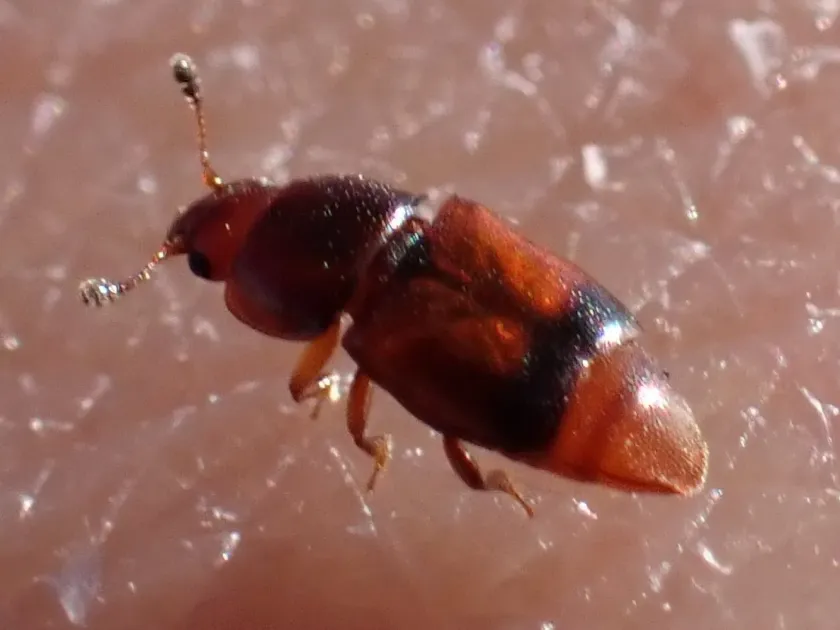
Carpophilus antiquus belongs to the family Nitidulidae, commonly known as sap beetles or dried fruit beetles. These are small insects, with adults typically measuring between 2 and 4 mm in length.
The beetle’s body is elongated and slightly flattened, usually ranging in color from dark brown to black, often featuring a distinct metallic or bronzed sheen. A defining anatomical characteristic is the shortened elytra, which leave the final abdominal segments exposed.
Larvae are creamy-white with a darker, brown head capsule. They are highly mobile and feed voraciously within the tissues of fruit. Once fully developed, they typically drop to the soil to pupate, completing their life cycle in the rhizosphere of the host plant.
This species is secretive, often dwelling within decaying organic matter, cracked bark, or damaged fruit. Their development is closely linked to fermentation processes, as they are attracted to the volatile compounds released by rotting vegetation.
Adults are strong fliers, which facilitates rapid colonization of orchards and vineyards. During the harvest season, when fruit sugars are at their highest, these beetles can swarm quickly, posing a severe threat to the ripening crop.
What it damages
Damage is caused by both adults and larvae feeding on fruit tissues. Carpophilus antiquus primarily attacks stone and pome fruits such as peaches, nectarines, apples, and pears, as well as clusters of ripening grapes.
While they show a strong preference for fruits that have already been compromised by mechanical injury, bird pecks, or existing rot, a large population can successfully attack healthy, ripening fruit, burrowing into the pulp.
In vineyards, the beetles penetrate fruit clusters, feeding on the juice of crushed berries. This activity promotes secondary infections by mold fungi and acetic acid bacteria, leading to the rapid decay of the entire bunch.
Beyond direct physical damage, these beetles are significant vectors for pathogens. By moving from decaying fruit to healthy ones, they transmit spores of fungi that cause severe post-harvest rot, rendering the crop unmarketable.
- Pulp consumption in peaches and nectarines.
- Secondary rot in grape clusters caused by larval feeding.
- Entry wounds on apples and pears leading to rapid decomposition.
- Increased incidence of fungal diseases in fallen fruit.
When it appears
The life cycle of Carpophilus antiquus is highly dependent on ambient temperatures and environmental humidity. Activity commences in late spring or early summer as temperatures rise, signaling the start of the breeding season.
The peak of population density coincides with the ripening phase of fruits. During this period, mass migration and feeding occur, making it the most critical time for monitoring and intervention in agricultural settings.
Multiple generations can occur within a single growing season. The developmental speed from egg to adult is shortened in warmer climates, allowing for exponential population growth if food sources are abundant.
The beetles overwinter as adults or pupae, hiding in soil, leaf litter, or crevices in tree bark. They remain in a state of diapause until environmental cues indicate the arrival of spring and suitable conditions for emergence.
Effective management requires monitoring during the pre-harvest phase. Identifying the presence of the beetle early allows growers to take preventive action before the population reaches an uncontrollable threshold during the ripening stage.
Control measures
The cornerstone of management is rigorous orchard sanitation. Removing fallen fruit and clearing away decaying material is essential to eliminate the food supply and breeding grounds required for the beetle to thrive.
Pheromone and food-based attractant traps are highly recommended to monitor population levels and suppress adult numbers. These traps should be deployed well before the fruit reaches maturity to intercept incoming swarms.
Insecticidal intervention should be used cautiously, adhering to pre-harvest intervals (PHI) to ensure the safety of the produce. Biological control agents may also be used in integrated pest management (IPM) programs.
Protecting fruit from external injuries is a key preventive strategy. Minimizing damage from birds, wasps, and other insects significantly reduces the entry points available for Carpophilus antiquus to initiate feeding.
Good agricultural practices, such as pruning to improve canopy airflow, help keep fruit dry. Lower humidity levels on the fruit surface discourage the start of the fermentation processes that are primary attractants for these beetles.
Taxonomy
- Latin name
- Carpophilus antiquus
- Order
- Coleoptera (beetles)
- Family
- Nitidulidae
- EPPO code
- CARHAN
Discussion
No discussions yet — be the first.