
Rape blossom beetle
Brassicogethes viridescens
Description
How to identify
The rape blossom beetle (Brassicogethes viridescens), formerly known as Meligethes viridescens, is a small beetle from the family Nitidulidae, commonly found in oilseed rape fields.
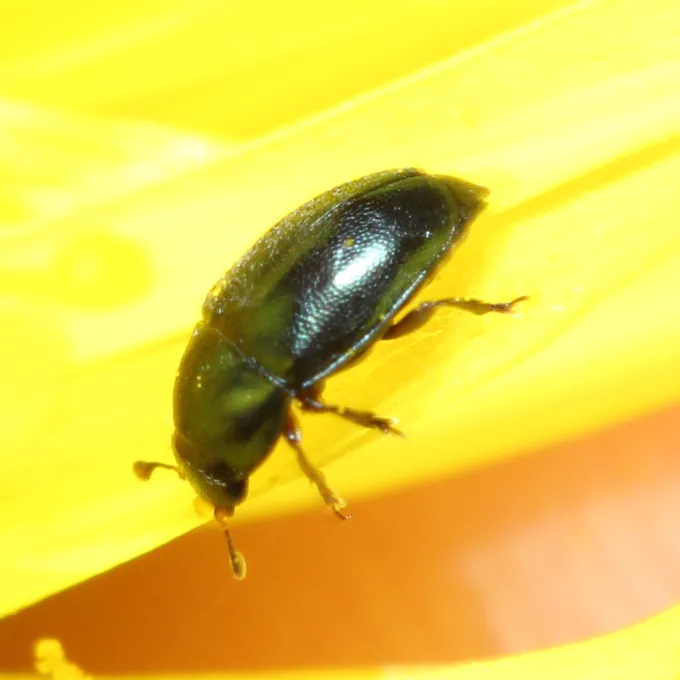
The adult beetle measures approximately 2 to 2.5 mm in length. Its body is oval, strongly convex, and displays a metallic dark blue or greenish-blue coloration.
The larvae are small, creamy-white to yellowish in color, with a dark head and thoracic shields. They are highly active and move quickly within the flower buds.
Eggs are minute, oval, and deposited by the females inside the closed flower buds, which provides the larvae with an immediate and protected food source.
Due to their small size and dark coloration, these beetles are often difficult to spot unless they are actively moving in large numbers across the plant canopy.
What it damages
Both adult beetles and larvae cause damage. Adults feed on the pollen and tissues inside the flower buds, often destroying the reproductive organs completely.
When the beetles eat into the buds to access pollen, the damaged buds wither, turn yellow, and eventually drop off, preventing the formation of siliques.
Larvae consume the remaining interior of the buds, causing further yield loss. If the infestation is high, significant portions of the racemes can be destroyed.
Plants compensate for this loss by producing more side branches, which leads to uneven ripening and delays in the harvesting process, ultimately reducing seed quality.
The most critical period for damage is during the green bud stage. If control measures are not taken, yield losses can be substantial, exceeding 50% in severe cases.
When it appears
Adult beetles overwinter in the upper soil layers, beneath plant debris, or in sheltered areas like forest edges. They emerge in early spring as temperatures rise.
Migration to rapeseed fields typically occurs during the budding stage, when the beetles feed on pollen from various plants before settling on the crop.
The lifecycle includes one generation per year. Mating occurs on the host plants, followed by oviposition within the flower buds over a period of several weeks.
After the larval stage is completed, the larvae drop to the ground and pupate in the soil. The new generation of adults emerges in late summer.
These new adults feed on the flowers of various weeds before entering diapause, retreating to their wintering sites as the autumn temperatures decrease.
Signs of infestation
The primary sign of infestation is the presence of holes in the flower buds, accompanied by premature yellowing and dropping of the buds from the raceme.
When disturbed, the adult beetles tend to drop from the plant or hide, making manual inspection a task that requires careful observation of the inflorescences.
Large numbers of beetles can be observed in the crop during warm, sunny weather, often concentrated on the most developed buds at the top of the plant.
In infested fields, plants often show a ragged appearance with gaps in the racemes where buds have failed to develop into pods, leading to stunted or distorted structures.
Monitoring using yellow sticky traps is a standard method to detect the initial arrival of the beetles and estimate the population density before it reaches damaging levels.
Control measures
Effective management begins with good agricultural practices, such as choosing vigorous crop varieties that can grow through the vulnerable budding stage quickly.
Crop rotation and maintaining spatial isolation between new rapeseed fields and previous year's infested fields are essential to disrupt the beetle's life cycle.
Insecticide application should be based on economic threshold levels to prevent unnecessary chemical use and to minimize the risk of insecticide resistance.
When chemical control is necessary, it is best to apply products in the early morning or evening to avoid harming beneficial pollinators visiting the field.
- Pyrethroid-based insecticides
- Neonicotinoid treatments
- Threshold-based spraying
- Integrated pest management
- Field monitoring with traps
Taxonomy
- Latin name
- Brassicogethes viridescens
- Order
- Coleoptera (beetles)
- Family
- Nitidulidae
- EPPO code
- MELIVI
Discussion
No discussions yet — be the first.