



SKU #60725
·
34 views
CR 7.6.1 X F 10.1
Sugar Beet
STRUBEUser rating
0 votes0% positive reviews
No ratings yet — be the first.
Root vegetable; size
Medium
Root; shape
Conical
Sugar Content
17-18%
Recommended Density
80-90 thous. pcs/ha, 90-100 thousand pcs/ha
About product

High-sugar hybrid with excellent root uniformity, designed for efficient mechanical harvesting and consistent industrial yield.
Root vegetable; size
Medium
Root; shape
Conical
Sugar Content
17-18%
Recommended Density
80-90 thous. pcs/ha, 90-100 thousand pcs/ha
Description
Maximizing Sugar Yield with Strube CR 7.6.1 X F 10.1
For agricultural enterprises focusing on industrial sugar beet production, the German-bred hybrid Strube CR 7.6.1 X F 10.1 represents a reliable choice for achieving consistent quality. Engineered for intensive cultivation, this hybrid balances root size with essential sugar content, ensuring high profitability per hectare.
Agronomic Profile and Performance
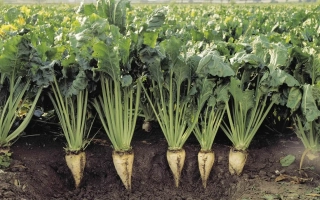
The hybrid produces medium-sized, conical roots. This shape is highly valued in modern farming as it significantly reduces soil adhesion and facilitates smooth mechanical harvesting. Key technical parameters include:
- Sugar Content: Consistently ranges from 17–18%, meeting the requirements for efficient industrial processing.
- Seeding Density: Recommended density is 80,000–90,000 plants per hectare for highly fertile fields, increasing to 90,000–100,000 plants per hectare in less favorable conditions to ensure optimal canopy closure and weed suppression.
Field Application and Operational Benefits
Strube CR 7.6.1 X F 10.1 is designed to simplify the harvest cycle. The uniformity and structural integrity of the root help prevent mechanical damage during lifting, which in turn reduces field losses and transport costs. Farmers selecting this hybrid can expect high responsiveness to fertilizer management and effective performance within standard herbicide protection programs. It is an ideal solution for operations seeking a predictable, high-quality raw product that maintains its chemical characteristics throughout the harvesting period, effectively mitigating the risks associated with varying soil moisture levels.
Crop & resistance
Crop
Specifications hover over for a hint about the specification
| Root vegetable; size | |
|---|---|
|
Root; shape
Root; shape
Roots can be round, elongated-round, cylindrical, conical. |
|
| Sugar Content | 17-18% |
|
Recommended Density
Recommended Density
Optimal productivity is achieved at a planting density of 4000-5500 plants/ha. Possible planting scheme: 300-500x40-80 cm. |
80-90 thous. pcs/ha, 90-100 thousand pcs/ha |
| Registration year | 2020 |
| Catalog | Catalog → Sugar Beet |
| Manufacturer | STRUBE |
| Country | Germany |
Store offers
Prices are updated on loadLoading offers…
Aggregator catalog: prices are collected automatically from store websites, normalized by AI and converted at the current exchange rate. Before ordering, confirm the price and availability on the store's website. This block is not indexed by search engines — the data is loaded after the page opens.
Not yet комментариев. Be the first!
Alternatives
Sugar beet seeds · similar varieties






See also
Often considered together with this variety





Recently viewed
Products you’ve viewed on this site
Reviews · 0