


SKU #45750
·
64 views
Campus
Radish
Rijk ZwaanUser rating
0 votes0% positive reviews
No ratings yet — be the first.
Root vegetable; color
Red, Purple, Yellow, White
Registration year
2007
About product

A high-tech hybrid designed for stable yields with a unique variety of root colors.
Root vegetable; color
Red, Purple, Yellow, White
Registration year
2007
Description
Technological potential of the Campus hybrid
The «Campus» radish from the Rijk Zwaan breeding house is a prime example of precise genetic engineering focused on high marketability in intensive vegetable farming. The key feature of this hybrid is its ability to maintain its internal structure even after prolonged time in the soil, which removes rigid limitations on harvest windows.
Root morphology and adaptability
Dutch breeders have integrated parameters into Campus that are critical for professional farming operations:
- Stability of form: the root crop possesses high uniformity, which minimizes the amount of off-grade produce during automated sorting.
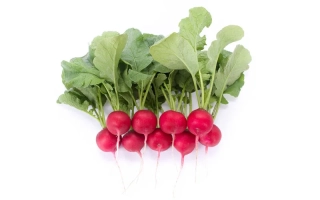
- Color spectrum: the hybrid demonstrates a wide palette driven by selective breeding: from saturated red to deep purple, yellow, and classic white shades. This makes it highly sought after in the segmented retail market (mix-salads).
- Internal architecture: the flesh is dense and prone to slow cavitation even under moisture stress, a result of work focused on cell wall turgor.
The practical implication of such a design is clear: reducing the risks of cracking and "woody" texture allows for the optimization of irrigation schedules without sacrificing produce quality.
Agrotechnical advantages
Rijk Zwaan's work on Campus has achieved a high level of resistance to environmental stressors, including temperature fluctuations and low light conditions during the off-season. The root collar system is engineered to ensure rapid development of the foliage, which remains compact enough to allow for high planting density per hectare. By choosing Campus, agronomists gain a predictable tool for both greenhouse and open-field cultivation, where the primary focus is on preserving the market appearance of the root crop throughout its entire growth cycle.
Crop & resistance
Crop
Specifications hover over for a hint about the specification
|
Root vegetable; color
Root vegetable; color
Carrot root can be orange, red-orange, pink, yellow, white, purple. The intensity of color depends on the content of pigments. |
|
|---|---|
| Registration year | 2007 |
| Catalog | Catalog → Radish |
| Manufacturer | Rijk Zwaan |
| Country | Netherlands |
Store offers
Prices are updated on loadLoading offers…
Aggregator catalog: prices are collected automatically from store websites, normalized by AI and converted at the current exchange rate. Before ordering, confirm the price and availability on the store's website. This block is not indexed by search engines — the data is loaded after the page opens.
Not yet комментариев. Be the first!
Alternatives
Radish seeds · similar varieties




See also
Often considered together with this variety




Recently viewed
Products you’ve viewed on this site
Reviews · 0