


SKU #4124
·
449 views
Peach Djaminate
Peach
Flavor of the fruit
Sweet and sour
Flesh
Soft
Pit
Easily removable
Fruit Shape
Oval
Your mark
1 vote
100% positive ratings
Store offers · 4 from 4 stores
4 offers in 4 stores — from 3.05 € per seedling.
Available at: Agro-market · biolocus-plant-pro · Eco-Sad24 · Наследие
Prices are collected automatically from store websites and converted at the current exchange rate. Check the price and availability on the store website before ordering.
Description
Seedling of unknown origin. Daghestan Fruit Tree Breeding Station. Author: Sh.G. Batyrkhannov. Approved for the North Caucasus region since 2000.
Medium-sized tree, medium-growing. Crown is spherical-oval and flat, of medium density. Branches are medium, straight, reddish-brown, green on the underside, red on the exposed side, bare, with few small buds, medium, white. Buds are triple, two lateral generative, middle vegetative. Generative buds are mainly located at the base and middle of the branch. Leaves are large, broad, elongated-elliptical, dark green, smooth, shiny. Leaf blade is curved downward with some wrinkling, apex gradually pointed, base pointed. Leaf margin finely serrated, base coarsely serrated. Petiole is long (10-11 mm), thick, pigmented, curved, with 2 rounded brown glands. Flowers are solitary, bell-shaped, medium, reddish.
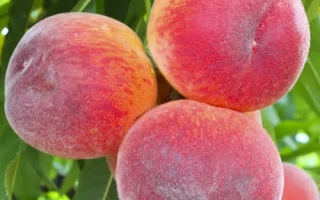
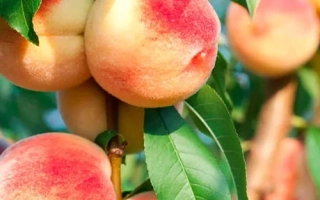
Fruits are large, one-dimensional, average fruit mass 130 g, maximum 160 g, height 65 mm, diameter in cross-section 60-57 mm, oval-elongated, pressed on sides. Apex of the fruit is medium-concave, with a depression on top, pit deep, up to 10 mm and 5 mm wide, ventral suture of medium depth, gradually deepening toward the apex, pedicel short, thick, firmly attached to the fruit. Main fruit color is yellow, covering dark-red marbled. Skin is medium, slightly pubescent, difficult to peel. Flesh is orange-yellow, tender, juice colorless, sweet with pleasant acidity. Pit is medium-large — 9.2 g, makes up 6.3% of fruit mass, separates well from flesh, egg-shaped, sloped in grooves. Fruits ripen simultaneously on the tree, transportable, store 10-15 days.
Fresh fruit taste rating: 4.7 points, compote rating: 4.7 points. Dry matter content in fruits — 10.31%, sugars — 7.49%, acids — 0.72%, ascorbic acid — 11.48 mg/100g.
Flowering period: April 15-18. Generative buds are not damaged by spring frosts, fruiting is annual. Age of fruiting onset: 3-4 years, fruiting mainly on mixed branches. Fruit maturity period: medium-late. Calendar dates for harvest readiness: September 1-2. Yield from 1983 to 2000: 109.5 centners/ha, maximum — 302 centners/ha. Variety is relatively resistant to scab, clasterosporiosis, and frost.
Crop & resistance
Crop
Disease resistance
Specifications
| Flavor of the fruit | |
|---|---|
| Flesh | |
| Pit | |
| Fruit Shape | |
| Fruit Color | |
| Fruit Weight | 130-160 |
| Tree Growth Type | |
| Fruiting (year after planting) | 3-4 |
| Storage Duration (days) | 10-15 |
| Features | |
| Catalog | Catalog → Peach |
No reviews yet. Be the first to share your experience.
Alternatives
Peach saplings · similar varieties






See also
Often considered together with this variety


Recently viewed
Products you’ve viewed on this site
Reviews