
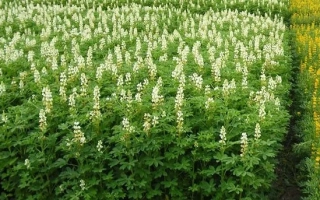

SKU #71884
·
51 views
SIDERAT 46
Lupin
User rating
0 votes0% positive reviews
No ratings yet — be the first.
Usage
Cover Crop
Plant Height
80-150
Recommended seeding rate, kg/ha
150-200
Green Mass Yield (t/ha)
30-50
Prices in stores
from0.68 €per 1 kg
pack from 6.78 € per 10 kg
1 offer from 1 store
Store offers · 1 from 1 stores
Prices are updated on loadLoading offers…
Available at: Sezon Agro
Aggregator catalog: prices are collected automatically from store websites, normalized by AI and converted at the current exchange rate. Before ordering, confirm the price and availability on the store's website. This block is not indexed by search engines — the data is loaded after the page opens.
About product

A high-yield biological nitrogen accumulator designed for intensive soil restoration and structure improvement.
Usage
Cover Crop
Plant Height
80-150
Recommended seeding rate, kg/ha
150-200
Green Mass Yield (t/ha)
30-50
Description
Biological Optimization of Soil Profiles
The «Siderat 46» lupine, developed by the V.R. Williams All-Russian Research Institute of Forage, is a specialized tool for intensive organic farming. The primary objective of this variety is the rapid accumulation of organic matter and nitrogen within the root zone.
Technical Development Parameters
The genetic potential of the variety allows for the development of robust vegetative biomass ranging from 80 to 150 cm in height. Under agro-ecosystem conditions, this provides significant weed suppression through effective soil shading. With a seeding rate of 150–200 kg/ha, the variety demonstrates a high tillering coefficient, producing green biomass yields of 30–50 t/ha. This volume of organic material not only provides physical soil structuring but also contributes to substantial enrichment in organic carbon.
Nitrogen-Fixation Efficiency
A critical technical metric for «Siderat 46» is its protein content in dry matter, which stands at 15–20%. From a technical perspective, this signifies a high capacity for biological nitrogen sequestration. When incorporated into the soil, the mineralization of nitrogenous compounds occurs, making nutrients readily available for subsequent crops in the rotation. The plant functions as a “green manure” with an efficacy comparable to significant applications of synthetic nitrogen fertilizers, simultaneously improving soil aeration and hydraulic conductivity through its deep taproot system.
Practical Applications
- Crop Rotation Optimization: A short development cycle allows for use both as a cover crop and a primary green manure for soil reclamation.
- Soil Structuring: Powerful taproots penetrate dense soil horizons, decompacting them without mechanical intervention.
- Phytosanitary Impact: Rapid biomass accumulation reduces the necessity for herbicide applications on the plot.
Crop & resistance
Crop
Specifications
| Usage | |
|---|---|
| Plant Height | 80-150 |
| Recommended seeding rate, kg/ha | 150-200 |
| Green Mass Yield (t/ha) | 30-50 |
| Protein content in dry matter (%) | 15-20 |
| Registration year | 2015 |
| Catalog | Catalog → Lupin |
| Legal data |
Show · 1
|
| Country | Russia |
Not yet комментариев. Be the first!


See also
Often considered together with this variety




Recently viewed
Products you’ve viewed on this site
Reviews · 0