


SKU #70133
·
54 views
SAIAN GIFT
Honeysuckle
User rating
0 votes0% positive reviews
No ratings yet — be the first.
Flavor
Sour-sweet
Bush height, cm
1.0–1.2
Assignment
For Fresh Consumption, Recycling
Registration year
2015
About product

A compact, high-yield variety with balanced flavor, ideal for both fresh retail and commercial processing.
Flavor
Sour-sweet
Bush height, cm
1.0–1.2
Assignment
For Fresh Consumption, Recycling
Registration year
2015
Description
Stability and Performance for Commercial Orchards
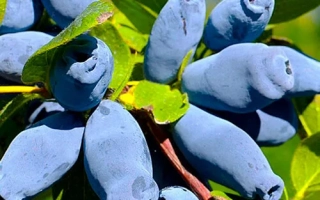
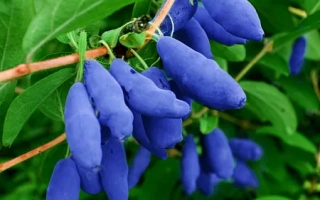
The «Podarok Sayan» honeysuckle variety, developed by the Krasnoyarsk Scientific Center, is designed for growers who prioritize consistent yields for both the fresh produce market and industrial processing. With a compact bush height of 1.0–1.2 meters, this variety is engineered for high-density cultivation, simplifying canopy management and harvest logistics.
Operational Advantages in Farming
- Harvest Efficiency: The manageable size of the bushes significantly reduces the time spent on manual picking, directly lowering labor costs and increasing the number of plants harvested per hour.
- Processing Versatility: Featuring a distinct sweet-and-sour flavor profile, the fruit is an ideal candidate for jams, juices, andIQF (Individual Quick Freezing) processing. The berries maintain their structural integrity during freezing, meeting the quality standards of premium markets.
- Market Logistics: The berries possess sufficient firmness to withstand handling and transportation, ensuring they reach retail shelves in top condition with minimal shrinkage.
Investing in «Podarok Sayan» allows producers to streamline their workflow. Because of its predictable growth habit and height, this variety works well in mechanized or semi-mechanized schemes, offering a stable ROI for those managing mid-to-large scale berry operations.
Crop & resistance
Crop
Specifications
| Flavor | |
|---|---|
| Bush height, cm | 1.0–1.2 |
| Assignment | |
| Registration year | 2015 |
| Catalog | Catalog → Honeysuckle |
| Legal data |
Show · 1 |
| Country | Russia |
Store offers
Prices are updated on loadLoading offers…
Aggregator catalog: prices are collected automatically from store websites, normalized by AI and converted at the current exchange rate. Before ordering, confirm the price and availability on the store's website. This block is not indexed by search engines — the data is loaded after the page opens.
Not yet комментариев. Be the first!
Alternatives
Honeysuckle saplings · similar varieties




See also
Often considered together with this variety




Recently viewed
Products you’ve viewed on this site
Reviews · 0