


SKU #62143
·
59 views
Konkord
Grape
LLC 'INNOVATIVE COMPANY 'TAMANSKY BIUser rating
0 votes0% positive reviews
No ratings yet — be the first.
Usage Group
Dining
Ripening Period
Medium, Mid-late
Yield
High
Bush Growth Power
Strong
Store offers · 2 from 2 stores
Prices are updated on loadLoading offers…
Available at: Агрус · Ecoveles · LeafLand · Sadovnikoff · Vino
Aggregator catalog: prices are collected automatically from store websites, normalized by AI and converted at the current exchange rate. Before ordering, confirm the price and availability on the store's website. This block is not indexed by search engines — the data is loaded after the page opens.
About product

Concord is a table and wine grape variety known for its high resistance to diseases, frosts, and phylloxera. It belongs to the medium or late ripening period, lasting from 126 to 186 days in different regions. The bushes of this variety are vigorous with high yields. Leaves are large and medium-sized, slightly dissected or almost entire, heavily pubescent on the underside, with an open, wide, arch…
Usage Group
Dining
Ripening Period
Medium, Mid-late
Yield
High
Bush Growth Power
Strong
Description
Concord is a table and wine grape variety known for its high resistance to diseases, frosts, and phylloxera. It belongs to the medium or late ripening period, lasting from 126 to 186 days in different regions. The bushes of this variety are vigorous with high yields. Leaves are large and medium-sized, slightly dissected or almost entire, heavily pubescent on the underside, with an open, wide, arched petiole sinus. Flowers are hermaphroditic, which promotes good pollination and fruit formation.
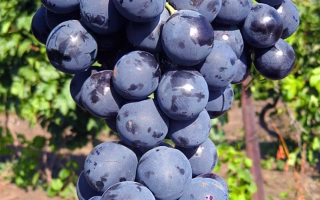
Concord bunches are medium to large in size, conical in shape with one or two wings, dense or moderately dense. The berries are large, round, dark blue with a thick skin and flesh that has the characteristic aroma described as "fox" or "strawberry". The berry skins are strong, ensuring good transportability and allowing grapes to be stored after harvest for up to one-two months. However, the berries tend to crack in high humidity and may slightly shed during ripening, so it is recommended not to delay harvesting.
The variety is widely grown in the USA, Canada, and regions with similar climatic conditions, including Odessa and Chisinau. Concord grapes are used both for fresh consumption and for making grape juice, jelly, dessert, and table wines. Wines and juices from this grape have a rich dark red color and a complex flavor bouquet. The variety is undemanding in care, prefers fertile soils and regular watering, especially during dry periods, and grows best in wind-sheltered areas.
Concord bunches are medium to large in size, conical in shape with one or two wings, dense or moderately dense. The berries are large, round, dark blue with a thick skin and flesh that has the characteristic aroma described as "fox" or "strawberry". The berry skins are strong, ensuring good transportability and allowing grapes to be stored after harvest for up to one-two months. However, the berries tend to crack in high humidity and may slightly shed during ripening, so it is recommended not to delay harvesting.
The variety is widely grown in the USA, Canada, and regions with similar climatic conditions, including Odessa and Chisinau. Concord grapes are used both for fresh consumption and for making grape juice, jelly, dessert, and table wines. Wines and juices from this grape have a rich dark red color and a complex flavor bouquet. The variety is undemanding in care, prefers fertile soils and regular watering, especially during dry periods, and grows best in wind-sheltered areas.
Video · 3 videos
Suggest a video →Crop & resistance
Crop
Disease resistance
Pest resistance
Specifications hover over for a hint about the specification
| Usage Group | |
|---|---|
|
Ripening Period
Ripening Period
It takes 70-100 days until pepper reaches flowering stage, 130-160 days until technical fruit ripeness, and 135-180 days until physiological ripeness. |
Medium, Mid-late |
|
Yield
Yield
Overall bulb harvest per unit area. Depends on both onion variety characteristics and agronomic practices, fertilizers, and irrigation. Under optimal growing conditions, an onion yield of 100 tons per hectare and above is not considered record-breaking. |
High |
| Bush Growth Power | |
| Flower Type | |
| Bunch Size | Large (500–800 g), Medium (300–500 g) |
| Berry Size | Large (5–8 g) |
| Berry Color | |
| Flavor | |
| Zoning | |
| Care Requirement | |
| Assignment | |
| Features | |
| Registration year | 2019 |
| Catalog | Catalog → Grape |
| Manufacturer | LLC 'INNOVATIVE COMPANY 'TAMANSKY BI |
| Country | Russia |
Not yet комментариев. Be the first!
Alternatives
Grapevine saplings · similar varieties

EXPECTED
Фгбоу Во Кубанский Государственный Аграрный Университет Имени И.Т.Трубилина
049 10 offers
2.58 €per seedling ≈ 133 ₴


See also
Often considered together with this variety





Recently viewed
Products you’ve viewed on this site
Reviews · 0