


SKU #3491
·
603 views
Purple Early Apple
Apple
User rating
0 votes0% positive reviews
No ratings yet — be the first.
Type of Sort
Sort
Tree; Growth Power
Tall
Tree; Canopy Shape
Broad canopy
Fruit; Fruit Shape
Flat-round
Prices in stores
from3.68 €per seedling
pack from 3.52 € per pack
13 offers from 3 stores
Store offers · 13 from 3 stores
Prices are updated on loadLoading offers…
Available at: AgronomVIP · Florashop · Ogorod · Agromir
Aggregator catalog: prices are collected automatically from store websites, normalized by AI and converted at the current exchange rate. Before ordering, confirm the price and availability on the store's website. This block is not indexed by search engines — the data is loaded after the page opens.
About product

Origin of the variety is unknown. Introduced to Minusinsk, Siberia, from Northern China by M. G. Nikiforov in 1892. It was widely cultivated in Siberian and Far Eastern gardens. Used by Siberian breeders as a source of winter hardiness in breeding programs. Considered the main seedling rootstock in Siberia. Used as a winter-hardy scaffold-forming rootstock. Approved for cultivation in the West Si…
Type of Sort
Sort
Tree; Growth Power
Tall
Tree; Canopy Shape
Broad canopy
Fruit; Fruit Shape
Flat-round
Description
Origin of the variety is unknown. Introduced to Minusinsk, Siberia, from Northern China by M. G. Nikiforov in 1892. It was widely cultivated in Siberian and Far Eastern gardens. Used by Siberian breeders as a source of winter hardiness in breeding programs. Considered the main seedling rootstock in Siberia. Used as a winter-hardy scaffold-forming rootstock. Approved for cultivation in the West Siberian and East Siberian regions since 1947. Not found in new plantings.
Trees are vigorous, with wide-oval crowns formed by strong scaffold branches extending from the trunk at acute, straight angles, with numerous buds and fruiting spurs.
Shoots are brownish-red, without pubescence. Leaves are medium-sized, broadly egg-shaped with a rounded base and long, broad tip, smooth, glossy, dark green, with serrated-margined edges, and glabrous on the underside. Petioles are short and slender, stipules are small and sickle-shaped.
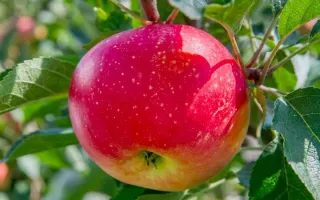
Fruits are extremely small (8-10 g), flat and flat-round in shape, dark red. Peduncles are thin and long. Calyx falls off. Receptacle is broad and smooth.
Flesh is yellow with red veins, firm, juicy, sour, bitter, and of poor flavor. Chemical composition of the fruit: total sugars — 12.8% (9.1-16.6), titratable acids — 2.47% (0.68-3.47), tannins — 554 mg/100g (360-1245), ascorbic acid — 28.0 mg/100g (12.5-42.7), P-active compounds — 866 mg/100g (644-1652), pectic substances — 7.69% on dry weight.
Harvesting begins in the first half of September, storage life up to 30 days. Widely used in winemaking.
Begins fruiting in the third year. High yield, irregular. High winter hardiness. Sensitive to scab.
Advantages of the variety: high winter hardiness and early fruiting, high yield.
Disadvantages of the variety: extremely small fruits of poor flavor, sensitive to scab.
Widely used by Siberian breeders as a base form in breeding for winter hardiness and early fruiting. Varieties such as Gornaltayskoe, Pepinka Altayskaya, Altayskii Golubok, Raneika Yermolaeva, Ulan-Udinskoe, Komsomolec Buryatiya, and others were developed using this variety.
Video · 1 video
Suggest a video →Crop & resistance
Crop
Specifications hover over for a hint about the specification
| Type of Sort | |
|---|---|
| Tree; Growth Power | |
| Tree; Canopy Shape | |
| Fruit; Fruit Shape | |
|
Fruit; flesh color
Fruit; flesh color
Color of the fruit flesh. There are red, pink, yellow, and brown colors. |
|
| Fruit; Fruit mass | 8-10 |
| Fruit; Lying | 1 |
| Cold Resistance | |
| Catalog | Catalog → Apple |
Not yet комментариев. Be the first!
Alternatives
Apple saplings · similar varieties




See also
Often considered together with this variety


Golden Kurish Renet (Winter Golden Renet, Zolotarevka, Zolotorovsky Renet, Rogulevka)
01.3K 1 offer
4.24 € ≈ 218 ₴


Recently viewed
Products you’ve viewed on this site
Reviews · 0