


SKU #3499
·
522 views
Kuban Renet
Apple
User rating
0 votes0% positive reviews
No ratings yet — be the first.
Type of Sort
Winter Apple Variety
Store offers · 6 from 6 stores
Prices are updated on loadLoading offers…
Available at: Botanicmarket · Чудеса Саду · Экосад · Квіти Буковини · Posadka · Сади Буковини · Саджанці дерев · Семена Буковины · Світ Рослин
Aggregator catalog: prices are collected automatically from store websites, normalized by AI and converted at the current exchange rate. Before ordering, confirm the price and availability on the store's website. This block is not indexed by search engines — the data is loaded after the page opens.
About product

A late-winter apple variety of intensive type, selected by the North Caucasus Regional Research Institute of Horticulture and Viticulture, obtained through clonal and mutational selection in vegetative offspring of the Renet Simirenko variety, subjected to a water solution of nitro-methylurea in 1969. In the epiphytotic year of 1972, a clone resistant to scab disease was selected. Breeder S. N. A…
Type of Sort
Winter Apple Variety
Description
A late-winter apple variety of intensive type, selected by the North Caucasus Regional Research Institute of Horticulture and Viticulture, obtained through clonal and mutational selection in vegetative offspring of the Renet Simirenko variety, subjected to a water solution of nitro-methylurea in 1969. In the epiphytotic year of 1972, a clone resistant to scab disease was selected. Breeder S. N. Artiukh.
In 1998, the Kuban Renet variety was included in the Register of Selection Achievements of Russia for use in gardens of the North Caucasus region. Currently, it is distributed throughout southern Russia and Ukraine.
The tree is low-growing, forming a flat-round, moderately dense crown with hanging lower branches. Branches in the first tier diverge from the trunk at a slight acute angle, and in subsequent tiers — at a right angle. The bark on the trunk and branches is gray, with brown, and on the southern side — with an orange tint. The fruiting type is mixed.
Shoots are thin, straight or slightly curved, brown, heavily hairy in the upper half, with very sparse, small tubercles. Leaves are medium-sized, oval-elongated, spirally medium-folded, slightly wrinkled, with smooth or serrated edges, rarely toothed, with a narrow, oval base with unequal lobes and a moderately expressed, smoothly tapering tip. Leaf blade is green or light green, glossy (in contrast to the original variety), forming a right angle with the stem. Petiole is medium-sized, often hairy and pinkish, as is the central vein. Stipules are small, lanceolate.
Flowers are saucer-shaped, white with cream-colored veins on petals. Style is short, hairy, stigmas positioned at the level of anthers. Flowering is medium-late.
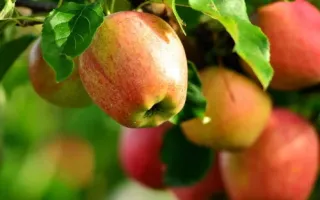
Fruits (see illustration) are medium or large. Most fruits in the crown are clearly asymmetrical, truncated-conical, flattened or more elongated vertically. Fruit surface is smooth or slightly ribbed. Main fruit color is bright green, with large white, round, dense subcutaneous spots (in contrast to the original variety, which has a more pronounced whitish bloom). On the southern side of fruits, well-exposed to sunlight, a dark raspberry blush develops by late September — October (in contrast to the original variety, which has an orange blush). This is especially characteristic in orchards with furrowed rows. Skin is smooth, dense, with moderate waxy coating (enhanced in storage), with a wide and deep rust-colored pit in the center, often with rays extending beyond its limits. Fruit stalk is thin and medium-length, without swellings, slightly curved. Calyx is wide, medium-depth, 5-ribbed with a 5-rayed ridge continuing along its walls, with a noticeable plateau at the base of the calyx lobes. Calyx is open or half-open. Subcalyx tube is conical or transitions into a narrow tube. Seed chambers are small, closed, axial cavity narrow. Seeds are small, flattened-round, brown.
Flesh is dense and very juicy when picked, pale greenish. At maturity — translucent greenish, creamy, of excellent sour-sweet flavor, with strong aroma. In storage, flesh becomes tender, aroma intensifies. Chemical composition of fruits: dry matter — 12.5–14.4%, sugars — 10.5%, titratable acids — 0.9%, ascorbic acid — 8.3–12.7 mg/100g, P-active substances — 90–140 mg/100g.
Fruits hold well in the crown until harvest maturity. Under normal storage conditions, fruits remain fresh until June and beyond. Transportability is high. Fruit quality is high — 90–92%. Excellent dessert flavor of fruits is preserved in processed products — juices, jams, purees, chips.
Variety is partially self-fertile. Best pollinators: Aydorod, Golden Delicious, Kuban Spur, Prikuban, Jonagold.
Trees begin fruiting on the 3rd–4th year on low-growing rootstocks (distinct feature), on medium-growing rootstocks — on the 4th–5th. Fruit production is without sharp periodicity (distinct feature). Productivity of the variety is high: on a high agro-foundation, especially with furrowed rows, average multi-year yields reach 400 centners per hectare and more; crown habit of the variety allows creating tree density of 1–2 thousand per hectare on low-growing rootstocks.
Winter hardiness of Kuban Renet is quite high: during the winter of 1993–1994, when trees of the original variety in orchards of many zones of the North Caucasus suffered severe damage or died, the new variety had damage ratings of 1–2 points, and already in 1995 it produced a good yield (Stary-Minsky fruit-growing farm — Steppe zone; OPH Central — Prikuban zone of Krasnodar Krai). Variety is undemanding, with polygenic resistance to diseases. Only in epiphytotic years, susceptibility to scab and powdery mildew increases to average levels.
Advantages of the variety: distinguished by rapid fruiting, high yield of high-quality marketable fruits, unique storability, high heat and drought resistance, and good winter hardiness.
Disadvantages of the variety: in epiphytotic years, protection is required against scab and powdery mildew.
Video · 6 videos
Suggest a video →Crop & resistance
Crop
Disease resistance
Specifications
| Type of Sort | |
|---|---|
| Catalog | Catalog → Apple |
Not yet комментариев. Be the first!
Alternatives
Apple saplings · similar varieties


See also
Often considered together with this variety


Renet Simirenko (Renet P. F. Simirenko, Green Renet Simirenko)
0619 2 offers
2.74 €per seedling ≈ 141 ₴


Champagne Renet (Paper Renet, Remarkable Renet, Paper Renet)
11.3K 3 offers
2.89 €per seedling ≈ 149 ₴


Recently viewed
Products you’ve viewed on this site
Reviews · 0