

Description
Symptoms
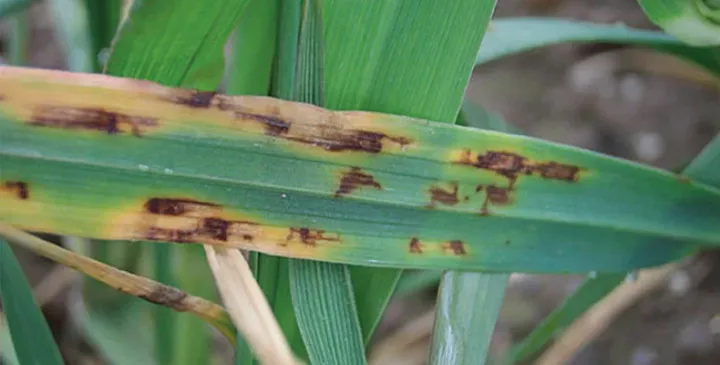
The primary symptom of the disease is the appearance of small, irregular leaf spots that gradually expand across the leaf surface.
These spots are typically dark brown or greyish and are often surrounded by a chlorotic yellow halo, indicating the production of fungal toxins.
Under humid conditions, the lesions can coalesce, leading to significant chlorosis and necrosis of the entire leaf, resulting in premature senescence.
A dark, velvety appearance may develop on the surface of the lesions, which corresponds to the sporulation structures of the fungus.
In severe cases, the infection may extend to the leaf sheaths and stems, causing structural weakness and potentially leading to lodging of the crop.
Pathogen
The fungus Pyrenophora biseptata (anamorph Drechslera biseptata) is a known pathogen that affects various cereal crops, including wheat and barley.
This fungus is an ascomycete that survives in crop debris, soil, and seeds, acting as the primary source of infection for subsequent growing seasons.
The pathogen utilizes a complex reproductive cycle involving both sexual ascospores and asexual conidia, which facilitate its spread across fields.
Once conditions are favorable, the fungus infects the leaves of host plants, colonizing the tissue and extracting nutrients for its development.
The ability of this pathogen to adapt to various environmental conditions makes it a persistent challenge for cereal producers globally.
Conditions for development
High humidity and moderate temperatures ranging from 15 to 25 degrees Celsius are optimal for the development and spread of the pathogen.
Prolonged periods of rainfall or heavy dew provide the necessary moisture for the germination of spores and the subsequent colonization of host tissues.
Dense crop stands create a favorable microclimate by retaining moisture, which increases the likelihood of rapid disease propagation within the field.
The presence of infected stubble on the soil surface allows the fungus to remain active and release spores during the early stages of crop growth.
Warm and wet weather patterns during the critical stages of grain development significantly amplify the risk of severe disease outbreaks.
Why it matters
The main damage caused by Pyrenophora biseptata is the reduction of the green leaf area, which severely limits the photosynthetic capacity of the plants.
Reduced photosynthesis leads to lower grain filling, resulting in shriveled kernels and a significant decrease in the overall test weight of the harvest.
Furthermore, the disease can impair the internal quality of the grain, reducing its nutritional value and germination potential for the next season.
Economic losses can be substantial, as crop yield reductions often reach double-digit percentages during favorable years for the pathogen.
Weakened plants are more susceptible to other biotic and abiotic stresses, which can lead to further secondary infections and reduced total field productivity.
Protection
The primary strategy for management is the use of disease-resistant varieties, which help suppress the development and spread of the fungus.
Cultural practices, such as burying crop debris through deep tillage, effectively reduce the initial inoculum density in the field.
Implementing a proper crop rotation scheme breaks the disease cycle and prevents the buildup of pathogen populations in the soil.
Seed treatment with fungicides is essential to protect emerging seedlings and prevent early-season infections that can jeopardize the entire crop.
Foliar fungicide applications during the vegetative stages are recommended if monitoring detects initial signs of the disease and weather conditions favor its spread.
Content graph
Connections · Pyrenophora biseptata
Most often together:
Marketplace
Products · 192
All 192
Fungicides 142
Wheat 42
Triticale 3
Herbicides, Desiccants 2
Plant Growth Regulators 1
Barley 1
Sugar Beet 1


Tabs, EV
Hailir Pesticides and Chemicals Group Co., Ltd, Shandong, КНР
Fungicides
0
0
·
49
7 offers
1.43 €per 1 l
Buy


Bolivar Forte
БІЛОЦЕРКІВСЬКИЙ ЗАВОД ПРЕПАРАТИВНИХ ФОРМ
Fungicides
0
0
·
45
24 offers
3.81 €per 1 l
Buy


Azox Duo
«Іпрохем (Тіанмен) Ко. Лтд.», Тіанмен, Китай
Fungicides
0
0
·
43
1 offer
13.04 €per pack
Buy


Rytivnik, w.g., (Tebuconazole, 500g/kg)
Jiang'an Agrin Company Ltd.
Fungicides
0
0
·
36
4 offers
0.21 €per pack
Buy



Tebuconazole-Star
Zhejiang Zhongshan Chemical Industry Group Co., Ltd.
Fungicides
0
0
·
29
4 offers
7.24 €per 1 l
Buy



Community
Discussion
No discussions yet — be the first.