
Korthalsella japonica
Korthalsella japonica
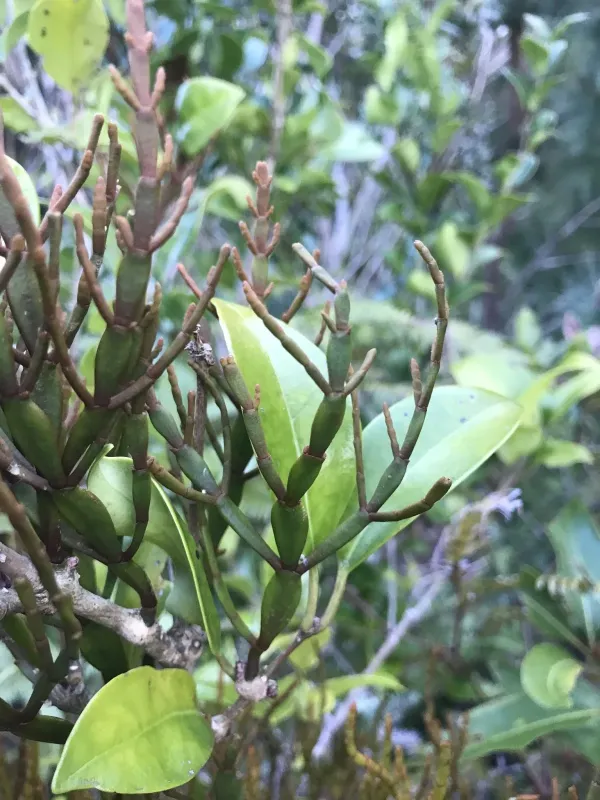
Description
Growing requirements
Korthalsella japonica is a perennial plant species belonging to the family Viscaceae, often classified within the Santalaceae family in modern botanical taxonomy. It is recognized primarily as a stem hemi-parasite, relying on host woody plants for survival.
The plant grows as an epiphyte on tree branches, where it develops haustoria to penetrate the host's tissues. This specialized attachment allows the plant to extract water and essential minerals from the host xylem, supporting its own metabolic and growth processes throughout the year.
Its natural range is distributed across East and Southeast Asia, including Japan, China, and parts of the Korean Peninsula. It thrives in temperate and subtropical forest ecosystems, favoring environments where specific host trees are abundant and humidity levels remain relatively stable.
Morphologically, Korthalsella japonica is characterized by its articulated, often flattened stem segments. The leaves are typically reduced or scale-like, which is a classic evolutionary adaptation for parasitic plants that minimizes transpirational water loss while maximizing energy efficiency.
Ecological requirements are highly specific to the tree species chosen as hosts. While the plant can perform limited photosynthesis due to its green tissues, it is heavily dependent on the health of the host tree and the ambient microclimate, which dictates the success of its seed germination and attachment phase.